Introduction
The question of why individuals or groups deviate from socially accepted norms and values has long occupied the attention of sociologists. While early sociological perspectives, such as those of Émile Durkheim, viewed deviance as a normal and functional aspect of social life, later theorists sought to explain its causes and variations in greater empirical and structural detail. Among these theorists, Robert K. Merton (1910–2003) stands out as one of the most influential sociologists of the twentieth century. His Strain Theory of Deviance—formulated most clearly in his seminal essay “Social Structure and Anomie” (1938)—represents a cornerstone of modern sociological thought.
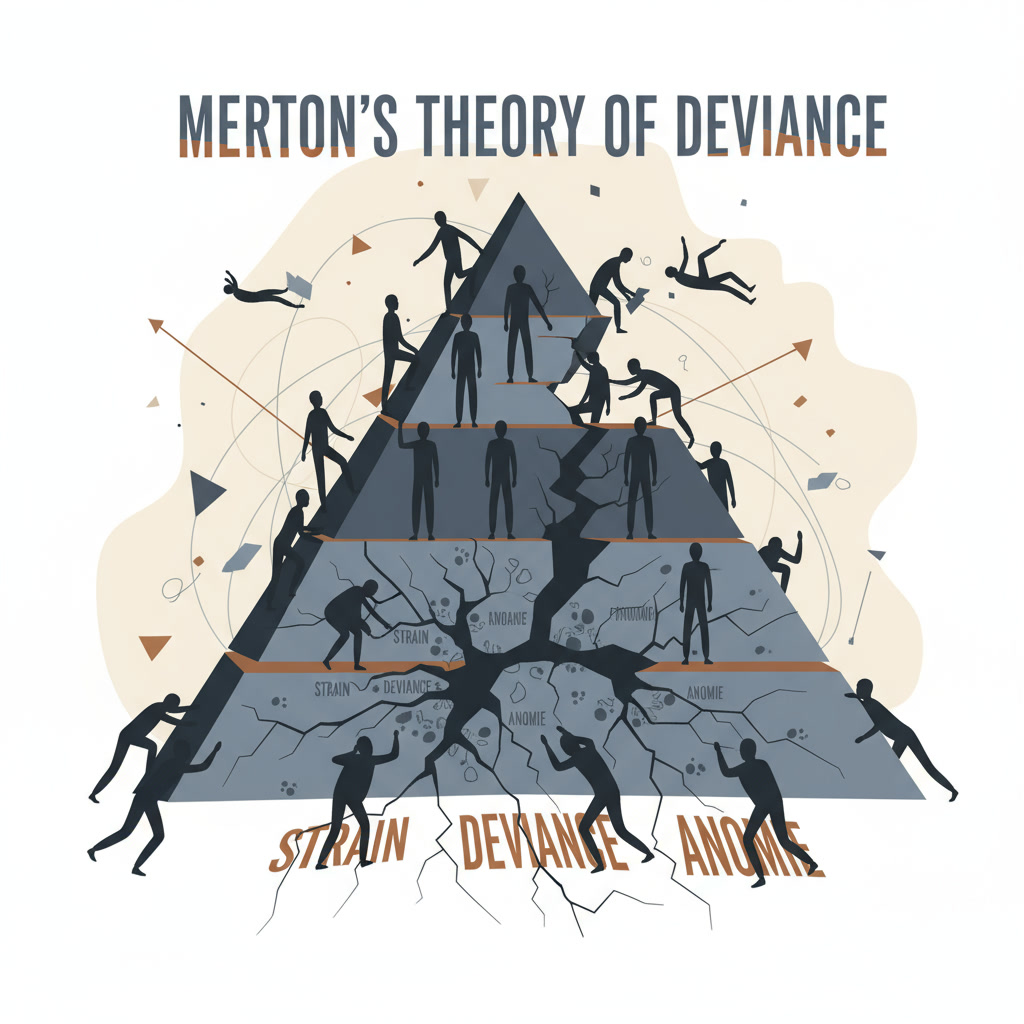
Merton’s theory fundamentally reorients the analysis of deviant behavior away from individual pathology and toward the structural properties of society itself. Drawing upon and revising Durkheim’s concept of anomie, Merton proposed that deviance arises not from the individual’s psychological flaws but from the tension—or strain—between culturally prescribed goals and the socially structured means available for achieving them. In doing so, Merton provided a sociological explanation of deviance grounded in the contradictions inherent in the organization of modern capitalist societies, especially the United States.
The Conceptual Background: From Durkheim to Merton
Merton’s theoretical innovation cannot be understood without situating it in relation to Durkheim’s classical conception of anomie. In The Division of Labor in Society (1893) and Suicide (1897), Durkheim employed the term anomie to denote a condition of normlessness—a breakdown or absence of normative regulation within a society. For Durkheim, anomie emerged particularly during periods of rapid social change, economic upheaval, or crisis, when traditional moral constraints weakened and individuals lacked clear guidelines for behavior. This absence of normative guidance produced feelings of restlessness, purposelessness, and disorientation, often manifesting in deviant or self-destructive acts, such as suicide.
Merton admired Durkheim’s insistence that deviance is a social, not merely individual, phenomenon. Yet he also found Durkheim’s conception of anomie too general and moralistic. Merton sought to transform the concept into a more precise sociological tool capable of explaining patterns of deviance in a stable social order, particularly within the structurally stratified context of American society. Rather than seeing anomie as the collapse of norms, Merton reconceptualized it as a discrepancy between culturally prescribed goals and the institutionalized means for achieving them. This reinterpretation shifted attention from the weakening of norms to the contradictions within the normative system itself.
American Society and the Cultural Emphasis on Success
Merton’s analysis begins with an observation of American culture. In his view, the United States is characterized by a pervasive cultural emphasis on material success and the “American Dream.” From early childhood, individuals are socialized into believing that success—typically measured in terms of wealth, status, and prestige—is both desirable and achievable through hard work, talent, and determination. Success is presented as a universal aspiration and a democratic possibility.
However, Merton argued that while the cultural system sets out this universal goal, the social structure does not provide equal access to the legitimate means for achieving it. Social stratification, inequality in education, economic opportunity, and systemic discrimination prevent large segments of the population from achieving success through socially approved channels. This disjunction between goals and means generates a sense of strain—a tension between what individuals are taught to want and what they can realistically achieve within the constraints of their social position.
This structural contradiction lies at the heart of Merton’s theory. Deviance, he argued, is not simply a matter of individual moral failure but a normal, adaptive response to the pressures exerted by this strain. People adjust to this disjunction in different ways, leading to varying forms of conformity and deviance.
The Structural-Cultural Framework: Goals and Means
Merton formalized his argument through what he termed the “structural-cultural” framework. This framework involves two interrelated components:
- Cultural Structure – the normative framework defining the goals and purposes deemed legitimate within a society (e.g., wealth, success, respectability).
- Social Structure – the organized, institutionalized means or procedures through which these goals may be legitimately pursued (e.g., education, employment, hard work, law-abiding behavior).
In an ideally integrated society, there is a balance between these two components: cultural goals are attainable through socially approved means. However, in societies like the United States, where the cultural emphasis on success is intense and the structural opportunities are unevenly distributed, a gap—or anomic strain—emerges. Individuals are pressured to achieve success by any means necessary, legitimate or otherwise.
Merton famously illustrated this with reference to American cultural mythology: “It is the American Dream that holds out the promise that anyone can make it if only they try hard enough.” Yet, when this promise proves illusory for many, frustration and innovation follow. Thus, deviance becomes not an individual aberration but a predictable social outcome of structural inequalities.
Modes of Individual Adaptation
To conceptualize the varied responses to this cultural-structural strain, Merton developed his classic typology of modes of individual adaptation. Each mode represents a distinctive pattern of behavior that emerges in response to the tension between culturally defined goals and the institutionalized means for achieving them.
| Mode of Adaptation | Cultural Goals | Institutional Means | Example |
|---|---|---|---|
| 1. Conformity | Accept | Accept | Law-abiding citizens who pursue success through hard work, education, and legitimate means. |
| 2. Innovation | Accept | Reject | Criminal entrepreneurs, con artists, or others who accept success goals but use illegitimate means to achieve them. |
| 3. Ritualism | Reject | Accept | Bureaucrats or clerks who abandon the success goal but rigidly adhere to rules and procedures. |
| 4. Retreatism | Reject | Reject | Alcoholics, drug addicts, or vagrants who withdraw from both goals and means. |
| 5. Rebellion | Replace | Replace | Revolutionaries who seek to replace existing goals and means with new systems. |
1. Conformity
Conformity represents the most common mode of adaptation. Most individuals continue to accept both the cultural goals and the legitimate means of achieving them, even when structural barriers exist. This mode ensures social stability, as conformists uphold the normative order.
2. Innovation
Innovation arises when individuals accept the dominant goals but lack access to the legitimate means of achieving them. They therefore turn to alternative—often illegitimate—means. Merton identified innovation as the primary source of deviant behavior in capitalist societies. Examples include white-collar crime, organized crime, or creative financial fraud. Importantly, innovation is not necessarily criminal—it can also describe creative or entrepreneurial behavior that challenges traditional methods.
3. Ritualism
Ritualists abandon the overarching cultural goals of success but continue to adhere strictly to the prescribed means. Their behavior is marked by excessive conformity to rules and routines. Ritualists may be found among lower-level bureaucrats or employees who follow procedures mechanically, even when these no longer serve their intended purpose. For Merton, ritualism exemplifies how individuals cope with strain by reducing aspirations to match available means.
4. Retreatism
Retreatists reject both the goals and means of society, retreating from active participation in social life. This mode includes chronic alcoholics, drug addicts, and others who “drop out” of society’s competitive race. Merton described retreatism as a form of escape—an adaptation characterized by resignation rather than rebellion.
5. Rebellion
Rebellion involves a radical rejection and replacement of both existing goals and means. Rebels seek to create a new social order based on alternative values and institutions. Revolutionary movements, countercultures, or utopian communities illustrate this type. Rebellion, for Merton, represents a transformative response to strain, attempting not merely to escape the system but to reconstruct it.
Merton’s Theoretical Logic: A Structural Functionalist Approach
Although Merton’s theory is often associated with conflict-oriented insights, it emerged within the framework of structural functionalism—a paradigm emphasizing the interdependence of social structures and the functions they serve in maintaining social order. For Merton, deviance was not a pathological disruption of the system but an inevitable outcome of its normal functioning. Every social structure, by its very organization, produces certain patterns of conformity and deviance.
He viewed deviance as a symptom of the malintegration between cultural and social structures. In this sense, Merton extended Durkheim’s insight that deviance performs social functions: it exposes the contradictions within the system and can prompt adjustments or reforms that restore equilibrium. Yet, unlike Durkheim, who emphasized moral integration, Merton emphasized structural inequality as the key source of strain.
Socioeconomic Context: Class and Opportunity Structures
Merton’s analysis implicitly links deviance to class position. The strain between goals and means is most acute among the lower strata of society, where opportunities for upward mobility are limited. Individuals in these groups are more likely to experience frustration and resort to innovative or deviant means. However, Merton also recognized that deviance occurs across class lines—white-collar crimes, for instance, are innovations by individuals with access to wealth and education but driven by the same cultural obsession with success.
Later sociologists, particularly Richard Cloward and Lloyd Ohlin in their Differential Opportunity Theory (1960), expanded on Merton’s idea by arguing that access to illegitimate means is also structured. Just as not everyone has access to legitimate opportunities, not everyone has equal access to criminal or deviant subcultures. Thus, deviant behavior is itself socially organized.
Criticisms of Merton’s Strain Theory
Despite its influence, Merton’s theory has attracted several critical objections from different theoretical perspectives.
1. Overemphasis on Lower-Class Deviance
Critics argue that Merton’s focus on the blocked opportunities of the lower class leads to a bias toward explaining working-class crime. This neglects other forms of deviance, particularly white-collar and corporate crime, which occur among those with full access to legitimate means. Although Merton did mention these, his framework is more often applied to lower-class deviance.
2. Cultural Homogeneity Assumption
Merton’s theory presumes a uniform cultural consensus on success goals (e.g., the American Dream). However, contemporary societies are culturally pluralistic, with multiple and sometimes conflicting value systems. The assumption of a single dominant cultural goal may therefore oversimplify the diversity of motivations within society.
3. Neglect of Power and Labeling
From a conflict or labeling theory perspective, Merton’s model does not adequately address how definitions of deviance are themselves socially constructed and enforced by powerful groups. Labeling theorists such as Howard Becker and Edwin Lemert argue that deviance is not inherent in particular acts but results from societal reactions and power dynamics that determine what counts as deviant.
4. Static and Structural Bias
Merton’s framework has been criticized for being overly structural and neglecting the subjective, interpretive dimensions of human action. It explains deviance as a response to structural strain but does not adequately explore how individuals perceive, interpret, or resist these pressures.
5. Neglect of Gender and Race
Feminist and postcolonial scholars have highlighted that Merton’s analysis largely ignores the intersectional dimensions of inequality. The experiences of strain differ along lines of gender, race, and ethnicity, shaping distinct patterns of deviance and conformity that the original theory does not fully capture.
Conclusion
Robert K. Merton’s Strain Theory remains one of the most profound and enduring contributions to the sociology of deviance. By linking individual behavior to structural contradictions between cultural aspirations and institutional realities, Merton shifted the study of deviance from moral and psychological explanations to a deeply sociological analysis of modernity itself.
His typology of adaptations—conformity, innovation, ritualism, retreatism, and rebellion—offers a timeless framework for understanding how individuals navigate the pressures of an unequal and goal-oriented society. Although subsequent developments have refined and sometimes challenged his theory, Merton’s insight into the social origins of deviance continues to illuminate patterns of crime, innovation, resistance, and reform in contemporary life.
In an age characterized by widening inequality, consumerist ideology, and digital disruption, Merton’s warning resonates with renewed force: when societies promise universal success but deny equal access to legitimate means, they cultivate the very deviance they seek to control. The strain between aspiration and opportunity is not a relic of mid-twentieth-century America—it is a defining feature of the global social structure in the twenty-first century.
References
- Agnew, R. (1992). Foundation for a General Strain Theory of Crime and Delinquency. Criminology, 30(1), 47–87.
- Cloward, R. A., & Ohlin, L. E. (1960). Delinquency and Opportunity: A Theory of Delinquent Gangs. Free Press.
- Cohen, A. K. (1955). Delinquent Boys: The Culture of the Gang. Free Press.
- Durkheim, É. (1897). Suicide: A Study in Sociology. Free Press.
- Merton, R. K. (1938). Social Structure and Anomie. American Sociological Review, 3(5), 672–682.
- Merton, R. K. (1968). Social Theory and Social Structure. Free Press.
- Messner, S. F., & Rosenfeld, R. (1994). Crime and the American Dream. Wadsworth.
- Parsons, T. (1951). The Social System. Free Press.