Introduction
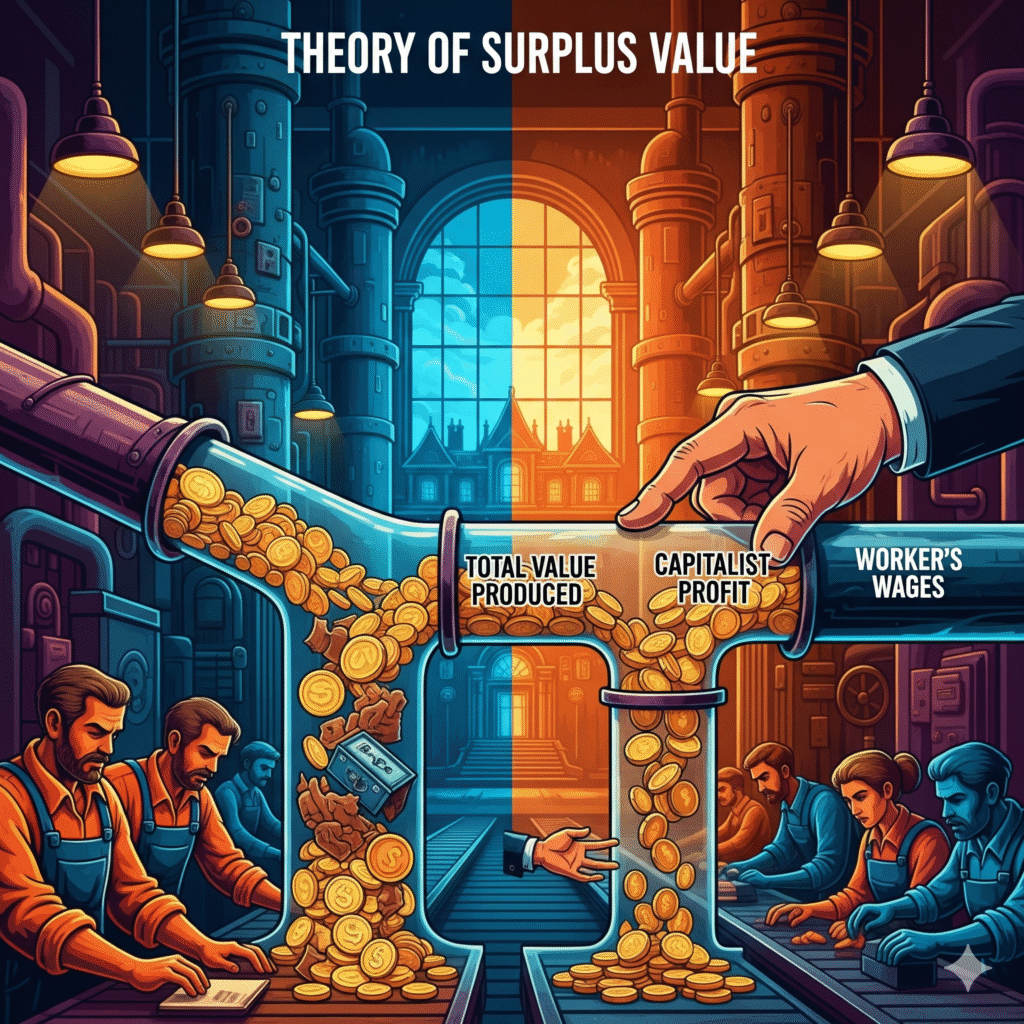
Surplus value is central to Marx’s critique of capitalism. In Marx’s view, the driving force of capitalist production is not the exchange of commodities for their fair values, but the extraction of extra value from workers. He describes this hidden process as the secret of “surplus value” – the way capitalists turn a wage-payed labour-time into a larger amount of value[1][2]. This secret resolves the seeming contradiction: in the market, commodities always sell at their labour-embodied values, so how can capitalists earn profit (more money out than they put in) without violating the rule of exchange? The answer lies in labour-power as a special commodity. A worker is paid a wage equivalent to the value of his/her labour-power (determined by subsistence needs), yet in use his/her labour produces far more value than this (because she works longer hours than needed to “reproduce” his/her wage). The surplus created beyond the cost of labour-power accrues to the capitalist as profit. As Marx famously summarizes, “the value of labour-power and the value which that labour-power creates in the labour-process, are two entirely different magnitudes,” and it is this difference that the capitalist seeks[1]. In short, Marx saw that capitalists buy labour-power at its value but appropriate unpaid labour – the surplus labour of the working day – as profit. This insight (that labour is the source of profit under capitalism) became what Marx called the “absolute law” of capitalist mode of production[2].
The Nature of Capitalist Exchange
Marx begins by contrasting simple commodity exchange with capitalist exchange. In a simple economy, an individual sells one commodity to buy another (the form C–M–C, commodity–money–commodity), and the goal is consumption or use. The worker sells a commodity (labour-power) and uses money to buy subsistence (C–M–C).
However, capitalists adopt the form M–C–M′: they start with money (M), use it to buy commodities (C) – chiefly means of production and labour-power – and end up with more money (M′). That extra money is profit. For example, a capitalist entrepreneur spends $27 on cotton, machinery wear-and-tear, and a day’s wage, and after production sells the output yarn for $30. On paper, this seems a fair exchange – each purchase was at full value – yet at the end “he withdraws 3 shillings more from circulation than he originally threw into it.”
As Marx describes: “Equivalent has been exchanged for equivalent… The capitalist…sells his yarn at its exact value. Yet for all that he withdraws [a surplus]… This metamorphosis, this conversion of money into capital, takes place… only in the sphere of production.”[3]. In other words, the capitalist’s profit does not come from cheating in the market of circulation, but from what happens in production – the application of labour-power. Thus the puzzle of profit is resolved: Capitalists legitimately buy inputs at value but use labour-power to create additional value (the surplus) during production.
So the capitalism’s goal is not final consumption but endless value expansion. Marx quips that capital is a kind of “dead labour that vampire-like only lives by sucking living labour”[4]. The basic question for Marx was: If everything exchanges at its value, where does the profit come from? This question or “mystery” is solved through M–C–M′, by understanding labour-power’s peculiar dual role: it is both a commodity with a price, and the source of new value when expended.
The Components of Surplus Value
To understand how surplus value arises, Marx identifies three interlocking components: his labour theory of value, the nature of labour-power as a commodity, and the division of the working day into necessary and surplus labour.
The Theory of Value
Marx adopts the labour theory of value: the value of any commodity is determined by the socially necessary labour time required to produce it. Concretely, each useful commodity embodies human labour in the abstract. “A use value has value only because human labour in the abstract has been embodied or materialised in it… The quantity of labour is measured by its duration, and labour-time finds its standard in hours.”[5]. In other words, once we abstract from the commodity’s particular usefulness, what all commodities share is human labour. Equal quantities of labour-time yield equal values: commodities containing the same socially necessary labour have equal value[6]. Socially necessary labour time means the labour time required by an average worker, with average skill and intensity, under normal conditions of production[5][6]. Thus, when productivity rises (so goods can be made faster), the socially necessary labour per unit falls, and the value of each unit falls accordingly[6][7]. This background theory implies that all value ultimately derives from labour: the only source of new value in production is the expenditure of human labour-time.
The Value of Labour Power
With this value basis established, Marx highlights a special commodity in capitalism: labour-power itself, the capacity to labour. A capitalist must purchase labour-power on the market. The price of labour-power – the wage – is determined, like any commodity, by the labour time necessary to produce it. In practice, this means the wage equals the value of the means of subsistence required to maintain the worker (and often her family) at a given standard. Marx writes: “The value of labour-power is determined, as in the case of every other commodity, by the labour-time necessary for the production, and consequently also the reproduction, of this specific article… Labour-time requisite for the production of labour-power reduces itself to that necessary for the production of the means of subsistence required by the labourer.”[8]. In simple terms, the wage covers only what is needed to keep the worker alive and able to work – food, clothing, shelter, education, etc. Thus labour-power is a commodity whose exchange-value is tied to social subsistence levels.
Crucially, labour-power’s use-value is the actual labour it can perform. When a capitalist “consumes” labour-power, the worker uses their body and mind to produce goods or services. As Marx notes, to the capitalist the worker’s labour must be used “in the most useful way”; what matters is not the value of labour-power (wage) but its capacity to generate value. The capitalist expects labour-power to produce more value than it costs. That “extra” production is the heart of surplus-value.
Necessary and Surplus Labour
Given the two previous elements, we see how surplus arises during the work-day. A worker sells an 8-hour day of labour-power at a wage that, say, represents 4 hours of labour-value (the means of subsistence worth 4 hours of work). In reality, the worker will labour for the full 8 hours. The first 4 hours of work produce value equivalent to his/her wage – this is necessary labour, reproducing the value of her labour-power. The remaining 4 hours produce surplus labour, generating new value beyond her own upkeep. Marx describes this division: “The working day in a capitalist enterprise is divided into necessary labour-time and surplus labour-time. During the necessary labour-time the worker reproduces the value of his labour-power, and during the surplus labour-time he creates surplus-value.”[9].
Importantly, this process occurs under conditions that on the surface look like fair exchange: the worker receives exactly the value of her labour-power, and the capitalist pays that full value. Yet in the production process, the worker actually creates twice as much value as is exchanged. As Marx observes, “the value of labour-power, and the value which that labour-power creates in the labour-process, are two entirely different magnitudes; and this difference of the two values was what the capitalist had in view, when he was purchasing the labour-power.”[1]. In our example, the value paid (4 hours) and the value produced (8 hours) differ by half (4 hours of surplus labour, equivalent to half the day). The capitalist then appropriates this surplus-value for himself.
Thus the three building blocks combine into a coherent explanation: commodities have value by abstract labour, labour-power is unique as a commodity because it can create more value than it itself has, and the working day is split so that part of it reproduces wages and the rest produces unpaid surplus. This is how capitalist production systematically generates surplus value from labour.
Understanding Surplus Value and Exploitation
Surplus value is the additional value produced by labour beyond what is paid in wages. Formally, if a worker produces commodities worth $100 in a day but is paid only $50, the surplus value is $50. Marx defines surplus value as “the value created by the labour of a wage-worker over and above the value of his labour-power and appropriated by the capitalist”[10]. It is literally the objective materialization of unpaid labour. In the above example, the worker labours 8 hours (creating $100), receives wages for only 4 hours ($50), and thus produces $50 of surplus-value for the capitalist. Marx also famously says that surplus value is “merely a congealed quantity of surplus labour-time… nothing but objectified surplus labour”[11].
This concept exposes the hidden exploitation in wage labour. Even though the labourer and capitalist appear to make a normal market exchange (wages for labour-power), the capitalist’s purchase is shrewd: he obtains more “use-value” (labour) than he pays for. Marx emphasizes that exchange at value does not prevent exploitation, because labour-power’s use-value is labour itself. As Marx explains, when a worker sells labour-power: “The seller of labour-power, like the seller of any other commodity, realises its exchange-value, and parts with its use-value… The owner of the money has paid the value of a day’s labour-power; his, therefore, is the use of it for a day… The very same labour-power can work during a whole day, [so] the value which its use during one day creates is double what he pays for that use… this circumstance is, without doubt, a piece of good luck for the buyer, but by no means an injury to the seller.”[12]. In effect, the worker is not injured by the exchange – he gets what he bargained for – but he is structurally compelled to labour beyond what his wages cover. The surplus value emerges from this extra labour, and is appropriated by the capitalist without any corresponding payment.
Thus surplus value directly measures exploitation: the ratio of surplus labour to necessary labour is the rate of surplus value (and rate of exploitation). But more fundamentally, the existence of surplus value shows that labour produces more value than its own labor-power value. This means that under capitalism the worker is systematically generating value that he does not receive. Even when paid “fairly” in terms of market prices, the worker’s labour is exploited because she is compelled to work unpaid hours. In Marx’s words, surplus value is the “absolute law” of capitalism[2] – capital cannot function except by continuously extracting unpaid labour from workers.
Mechanisms of Increasing Surplus Value
Capitalists employ two main methods to raise the surplus value they obtain: extending absolute labour time or increasing productivity (relative surplus value). Both are expressions of the same goal (more unpaid labour) but take different forms.
- Absolute Surplus Value: This involves prolonging the working day itself. By making the worker labour longer hours under the same wage, the portion of the day that is unpaid (surplus labour) grows. For example, if a 10-hour day yields $100 of output (with $50 covering wages for 5 hours), extending it to 12 hours raises output to $120, with a larger unpaid portion. As Marx notes: “The prolongation of the working-day beyond the point at which the labourer would have produced just an equivalent for the value of his labour-power… and the appropriation of that surplus-labour by capital, this is production of absolute surplus-value.”[13]. This was historically the simplest method under early industrial capitalism: just make workers toil from dawn till dusk. Laws limiting work hours (factory acts, etc.) were often only won through struggle after capital had pushed hours to the limit. Absolute surplus value depends solely on lengthening labour time without changing technology or intensifying labour per hour.
- Relative Surplus Value: This method increases surplus value within a given day by reducing the amount of labour-time needed to produce the worker’s wage (i.e. necessary labour), thus raising surplus labour proportionately. This is achieved through raising productivity, especially in the production of workers’ consumption goods and tools. For example, if technological improvements allow bread to be produced with 4 hours of labour instead of 6, then a worker who needs 6 hours of work to earn his bread wage before now needs only 4 hours. If the working day remains 10 hours, surplus labour time rises from 4 hours (from 10–6) to 6 hours (from 10–4), increasing surplus value. Marx explains: “[Relative surplus-value production] presupposes that the working-day is already divided into necessary labour and surplus-labour. In order to prolong the surplus-labour, the necessary labour is shortened by methods whereby the equivalent for the wages is produced in less time… The production of relative surplus-value revolutionises… the technical processes of labour.”[14]. In practice, the spread of labor-saving machinery, the organization of labour (division of labour, co-operation, assembly lines), and improvements in agriculture all serve to shrink necessary labour time. The result is a general increase in the rate of exploitation across the economy, even if the nominal work-day stays the same or shortens.
Crucially, absolute and relative surplus value are complementary and co-exist in capitalist development. When the working day becomes socially or legally constrained, capitalists shift to relative methods (productivity growth) to raise surplus value. Conversely, technological advances often revive pressures for longer hours (as capitalists capture the gains). Marx emphasizes that absolute surplus value hinges on the duration of the working day, while relative surplus value depends on transforming the conditions and organization of labour (raising productivity)[15][16]. Both strategies ultimately increase the unpaid labour drawn from workers and hence the capitalist’s revenue.
Significance of Surplus Value in Marxian Theory
Class Relations
Surplus value is not just an economic concept; it defines the fundamental social relation between classes under capitalism. It makes clear that capitalists and workers are in opposing positions: capitalists own the means of production and demand surplus labour, while workers must sell their labour-power to survive. As Marx puts it, capitalist production is essentially the production of surplus-value. “The labourer produces, not for himself, but for capital… That labourer alone is productive, who produces surplus-value for the capitalist.”[17]. In other words, a worker only counts as a ‘productive’ member of society insofar as she contributes to capital accumulation. This hardens a class division: the capitalist class lives off the unpaid labour of the working class. Capital can only yield income (profit) by extracting labour, and workers, having no means of production, must supply it. Surplus value thus lies at the core of the capitalist-worker relationship. It explains why the capitalist “cooperates” with labour (providing tools, organizing work) – not out of shared interest, but to extract more surplus, and why any improvement in the worker’s skills or efforts goes to the benefit of capital unless wages rise correspondingly. The dynamics of surplus value unmask the economy as a social struggle: capitalists seek to maximize surplus extraction, while workers seek to minimize it (through higher wages, shorter hours, better conditions). This antagonism becomes the object of class conflict and labor movements. As Lenin noted, the doctrine of surplus value “gave the working class a spiritual weapon for overthrowing capitalism”[18], because it illuminates that workers do not gain from the wealth they create – it all goes to capital.
Historical Specificity
Surplus value, as Marx stresses, is specific to capitalist society. In pre-capitalist societies (slavery, feudalism), exploitation had different forms (slaves directly owned, serfs bound by obligation), and surplus was taken through force or custom, not through wage labour. What is unique in capitalism is that exploitation is hidden under market exchange and mediated by the purchase of labour-power. No slave or serf ever appeared to “sell” their labour as a commodity – whereas modern workers regularly do. Only in capitalism does the worker sell her capacity to labour as a commodity while being compelled to work extra hours for free. Capital itself emerges historically as “not a thing but a social relation”[19]: the tools and machines become capital only when owned privately and used to exploit wage-labour, a relation that dissolves with the end of capitalism. This means surplus-value is not an eternal law of all economies, but rooted in the capital-labour social relation. Marx’s analysis underscores that only under capitalist production does labour-power have this double character and create value above its own price. As such, surplus value reveals the historically specific process by which capitalism enriches a few through the labor of many.
Alienation of Labor
Surplus value also drives the alienation that Marx discusses elsewhere. Under capitalism the worker’s activity is no longer at her own direction: she works for the capitalist’s objectives and under his conditions. The product of her labour does not belong to her. Instead, “the seller of labour-power… parts with its use-value” – once sold, the worker no longer owns the labour she expends[20]. The entire working day beyond what replaces the wage is done “for free” – literally giving her labour away. In producing surplus value, the worker is alienated from the product, from the process of work, and from her own species-being. She creates values that belong to another class. This estranges workers from the meaning of their labour, reducing work to mere toil. Over time, this can manifest as a loss of control, boredom, or even hostility toward one’s work, since the fruits of labour are confiscated as surplus. In short, surplus-value creation turns labour into a source of profit for someone else, deepening Marx’s point that under capitalism the worker is alienated from the value she produces.
Conflict and Social Change
Because surplus value depends on the length and intensity of work, it is inherently contested. Workers naturally resist extension of the working day and demand better wages or conditions to claim more of the value they produce. Capitalists, in turn, constantly seek to increase surplus (through longer hours, cheaper labour-power, or higher productivity). This underlying tension fuels class conflict. Strikes for shorter hours, higher pay, unionization, and political struggle over labour laws can all be seen as workers’ attempts to wrest back some of the surplus-value. On the other hand, capitalists and their governments may counter with repressive measures or strategies to pit workers against one another. Marx argued that these conflicts are intrinsic to capitalism’s structure, not aberrations. Indeed, he saw historical change coming from this contradiction: the same process that drives accumulation and productivity also produces class consciousness and crises that can overturn capitalist relations. As one commentator summarizes, under capitalism “the pursuit of surplus-value is the principal driving-force of the development of the productive forces”, a potency unmatched by earlier exploitative societies[21]. In Marx’s sociological vision, surplus value is the lens through which one understands why and how capitalism constantly restructures society (through industrialization, urbanization, globalization) while simultaneously sowing the seeds of its own transformation via class struggle.
Critiques of Marx’s Theory of Surplus Value
Marx’s theory of surplus value has drawn criticism from various quarters. Böhm-Bawerk, a leading Austrian economist, argued that Marx had confused the categories of profit and interest and that his labour theory of value contained internal logical problems. Böhm-Bawerk claimed that Marx’s system leads to paradoxes – for example, it seemed (in Böhm-Bawerk’s view) to imply that because labour produces surplus value, workers should logically receive wages covering all value created, collapsing the profit motive. He criticized the notion of labour-power as a commodity, asking in effect: if labour-power is produced, who are its producers and how is its “socially necessary labour-time” measured? In sum, Böhm-Bawerk accused Marx of building on a circular logic and of ignoring the roles of capital, time preference, and entrepreneurship. As one account notes, early 20th century economists “raised questions about the logic of the labor theory itself and the inconsistencies of Marxist theory with the empirical workings of real market processes”[22]. In brief, neoclassical critics typically assert that profit arises not solely from exploitation of labour, but from capital’s productivity, innovation, and risk-taking. They maintain that factors like entrepreneurship, technology, and consumer preference can generate profit margins, and that wages and profits are determined by marginal productivity rather than strictly by labour content.
Joseph Schumpeter had a more nuanced take. He acknowledged Marx’s dynamism but contended that capitalism’s chief legacy was creative innovation, not inevitable collapse. Schumpeter pointed out that Marx’s idea of labour-power being paid at subsistence value glossed over how social standards of living (and thus workers’ “needs”) vary over time and place. In Schumpeter’s words, the capitalist and worker are in “primarily one of cooperation,” and long periods of capitalism can continue even if Marx predicted instability. Schumpeter suggested Marx gave too little credit to the roles of credit, banking, and technical progress in generating profit. However, Schumpeter also respected Marx’s insights into bourgeois accumulation – famously noting that Marx’s description of the bourgeoisie revolutionizing production was striking[23].
Despite these critiques, many sociologists and heterodox economists still regard surplus value as a vital analytical tool. They argue that even if the labour theory of value isn’t empirically exact in all details, the concept of surplus extraction captures real social relations of power and inequality in capitalism. Modern scholars like Erik Olin Wright (for example) use concepts like exploitation (the surplus-value idea rephrased) to analyze class structures. In sociology, surplus value functions less as a precise economic formula and more as a lens to see exploitation and class conflict embedded in wage labour. In other words, critiques may dispute the mechanics, but the core insight – that capitalism’s profit comes from uncompensated labour – remains influential in social theory.
Conclusion
Surplus value is more than an abstract economic formula in Marx’s theory – it is a sociological lens on capitalism’s dynamics. By revealing how profit is born from unpaid labour, surplus-value theory exposes the hidden class relations and power imbalances of market society. It shows why capitalists are not simply ingenious producers, but purchasers of labour-power whose profits come from the labour they purchase. As Marx insisted, “Production of surplus-value is the absolute law of this mode of production”[2]. Understanding surplus value thus means understanding the exploitative heart of capitalism: a system where money begets more money only through the living labour of workers. In the end, surplus-value is not just an “economic” concept but a key to the social and historical understanding of capitalism – explaining why the system generates inequality, conflict, and repeated crises of distribution, and why it has the capacity to transform society in profound ways.
References:
- Böhm-Bawerk, E. von. (1896). Karl Marx and the close of his system: A criticism. (A. M. Macdonald, Trans.). London: Fisher Unwin.
- Marx, K. (1976). Capital: A Critique of Political Economy, Volume I (B. Fowkes, Trans.). Penguin Books. (Original work published 1867)
- Schumpeter, J. A. (1942). Capitalism, Socialism and Democracy. New York: Harper.
[1] [3] [12] [20] Economic Manuscripts: Capital Vol. I – Chapter Seven
https://www.marxists.org/archive/marx/works/1867-c1/ch07.htm
[2] [4] [9] [10] [18] [19] [21] Political Economy
https://www.marxists.org/subject/economy/authors/pe/pe-ch07.htm
[5] [6] Economic Manuscripts: Capital Vol. I – Chapter One
https://www.marxists.org/archive/marx/works/1867-c1/ch01.htm
[7] [13] [14] [15] [16] [17] Economic Manuscripts: Capital Vol. I — Chapter Sixteen
https://www.marxists.org/archive/marx/works/1867-c1/ch16.htm
[8] Economic Manuscripts: Capital Vol. I – Chapter Six
https://www.marxists.org/archive/marx/works/1867-c1/ch06.htm
[11] Das Kapital, Volume I – Wikipedia
https://en.wikipedia.org/wiki/Das_Kapital,_Volume_I
[22] Eugen von Boehm-Bawerk’s Critique of Karl Marx | Mises Institute
https://mises.org/podcasts/marx-and-marxism/eugen-von-boehm-bawerks-critique-karl-marx
[23] George Catephores, The Imperious Austrian: Schumpeter as Bourgeois Marxist, NLR I/205, May–June 1994