Introduction
Imagine you are standing outside a large, unfamiliar building and you want to understand what lies inside. If you look through just one window, you will only ever see one corner of the room. Move to a second window, and a wider picture begins to emerge. Look through a third window from yet another angle, and now you can triangulate your observations to construct a far more complete and reliable understanding of the interior. This everyday analogy lies at the heart of a concept that has become central to social research: triangulation.
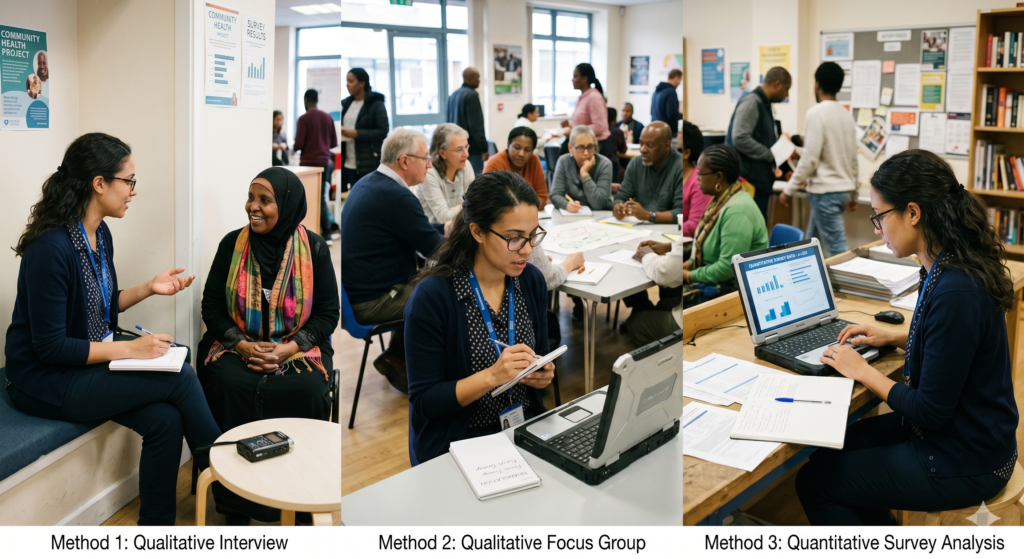
Social reality is not a simple, single-dimensional phenomenon. Human behaviour, social institutions, cultural norms, and lived experiences are complex, layered, and often contradictory. No single research method, no matter how sophisticated, is capable of capturing the full texture of social life. Every method carries within it a set of assumptions, strengths, and blind spots. The interview is rich in personal meaning but cannot guarantee candour. The questionnaire is economical and scalable but flattens nuance. Observation captures what people actually do but may miss what they privately believe. It is this fundamental limitation of any single method that gives triangulation its intellectual power and practical necessity.
In the simplest terms, triangulation refers to the use of multiple methods, data sources, investigators, or theoretical perspectives in the study of the same social phenomenon, with the aim of producing a more accurate, valid, and comprehensive understanding. It is, in essence, a strategy for overcoming the partiality that is inherent to any single approach to knowing the social world.
This article explores triangulation in detail: its conceptual origins, its various forms, its uses and purposes, its advantages, its critics, and how it is practically applied in sociological and social science research. The goal is not merely to define triangulation but to understand why it matters, how it works, and what its use says about the very nature of social inquiry.
The Concept of Triangulation: Origins and Meaning
Where Does the Term Come From?
The term triangulation is borrowed from navigation, surveying, and military science, where it refers to a technique for determining the position or distance of an unknown point by measuring angles to it from two known points at either end of a fixed baseline. The geometric logic is elegant: if you know the length of one side of a triangle and the angles at both ends, you can calculate all other dimensions with mathematical certainty. Surveyors have relied on this principle for centuries to map territories accurately.
In social research, the American sociologist Norman K. Denzin was among the first to formally introduce and systematically develop the concept of triangulation as a research strategy. In his landmark 1970 work, The Research Act in Sociology, Denzin argued that just as land surveyors triangulate physical positions to achieve accuracy, social researchers should triangulate their findings by approaching the same social phenomenon from multiple methodological directions. The underlying logic is the same: reliability and accuracy are best achieved not through a single measurement, but through the convergence of multiple independent measurements.
| KEY IDEA Just as a surveyor uses three points to confirm the location of an unknown position in space, a social researcher uses multiple methods, sources, or theories to confirm the validity of an interpretation of social life. The convergence of findings from independent approaches gives the researcher far greater confidence in their conclusions. |
The Epistemological Basis of Triangulation
Triangulation is not merely a technical trick. It is grounded in a deeper epistemological argument about how we can know the social world. Epistemology refers to the branch of philosophy concerned with the nature, sources, and limits of knowledge. In social science, a key epistemological debate concerns whether there is a single, objective social reality that researchers can directly access, or whether social reality is always interpreted, constructed, and partial.
Triangulation has been used by researchers operating within different epistemological traditions. For positivist researchers who believe in an objective social reality, triangulation serves as a means of converging on the truth: if two or more independent methods produce similar findings, this convergence is taken as evidence that those findings are accurate reflections of reality. From this perspective, triangulation is a validity-enhancing technique.
For interpretivist or constructivist researchers who are more sceptical about the idea of a single objective reality, triangulation serves a different purpose. Rather than seeking convergence, they value triangulation for the different perspectives and layers of meaning it reveals. When methods produce different findings, this divergence is not seen as a problem to be resolved, but as an illuminating signal that social reality is itself multi-dimensional and context-dependent. This approach is sometimes called crystallisation, a metaphor used by Laurel Richardson to describe how different methodological lenses refract the social world in multiple directions simultaneously.
Understanding this epistemological distinction is important because it shapes what researchers expect from triangulation and how they interpret their results. It is one reason why the concept has been applied in diverse and sometimes conflicting ways across the social sciences.
Denzin’s Four Types of Triangulation
Norman K. Denzin identified four principal types of triangulation. Each addresses a different dimension of the research process and each carries its own logic and implications. These four types have become the standard framework for understanding triangulation in social research methodology.
| Type of Triangulation | What Is Combined | Primary Purpose |
| Data Triangulation | Multiple data sources (time, space, persons) | Check consistency across sources |
| Investigator Triangulation | Multiple researchers or observers | Reduce observer/investigator bias |
| Theory Triangulation | Multiple theoretical perspectives | Examine phenomenon from competing frameworks |
| Methodological Triangulation | Multiple research methods | Overcome limitations of any single method |
Data Triangulation
Data triangulation involves the use of multiple and varied data sources in a single study. Rather than relying on a single type of data, the researcher gathers information from different social settings, different time periods, or different groups of people in order to check whether the patterns observed in one data source are consistent with those found in others.
Denzin sub-divided data triangulation into three categories: time triangulation, where data is collected at different points in time to account for possible change; space triangulation, where data is collected across different geographic or social settings to test for cultural or contextual variation; and person triangulation, which itself involves three levels: the individual, the group, and the collective.
Consider a researcher studying experiences of poverty in a particular region. She might interview individuals living in poverty at one point in time, then revisit the same individuals six months later to see how their circumstances and perspectives have changed (time triangulation). She might also collect data from both urban and rural poor communities to examine whether the experience of poverty differs by setting (space triangulation). And she might gather data from individual respondents, from family groups discussing poverty together, and from community organisations working with the poor (person triangulation). Together, these multiple data sources paint a far richer and more reliable picture than any single source could provide.
Investigator Triangulation
Investigator triangulation involves using more than one researcher, interviewer, or observer to collect, record, or analyse the same data. This approach is premised on the recognition that all researchers bring their own personal values, theoretical assumptions, cultural backgrounds, and interpretive habits to the research process. These subjective elements are often called researcher bias, and they represent a significant potential threat to the validity of research findings.
When two or more researchers independently observe the same social event, conduct separate interviews with the same respondents, or independently analyse the same qualitative data, any areas of agreement between them carry considerably more weight. If investigators with different personal backgrounds and academic perspectives arrive at the same conclusions independently, the researcher can have far greater confidence that these conclusions reflect something real about the social world rather than being artefacts of one researcher’s particular perspective.
This type of triangulation is particularly significant in ethnographic research and qualitative content analysis, where the researcher is often described as the primary instrument of data collection and interpretation. The personal presence of the researcher in the field inevitably shapes what they notice, what they record, and how they make sense of it. Investigator triangulation is therefore not merely a methodological safeguard; it is also a reflexive practice that foregrounds and critically addresses the role of the researcher’s subjectivity in the production of knowledge.
Theory Triangulation
Theory triangulation, also called theoretical triangulation, involves applying multiple theoretical frameworks or interpretive lenses to the analysis of the same body of data. Rather than viewing the social world exclusively from one theoretical perspective, the researcher examines it through the lens of several competing or complementary theories to see what each reveals that others might not.
In sociology, this might mean bringing together structural functionalism, conflict theory, symbolic interactionism, and feminist theory to analyse the same social institution, such as the family or the education system. Each theoretical perspective asks different questions and highlights different features of the social phenomenon under investigation. Structural functionalism would ask how the family serves the needs of society as a whole. Conflict theory would ask whose interests the family serves and how it reproduces social inequality. Symbolic interactionism would ask how meaning is created and negotiated within family relationships at the level of everyday interaction. Feminist theory would ask how gender power relations shape and are shaped by family life.
As the uploaded source material notes, theoretical triangulation is not widely practised among sociologists, largely because most researchers work from within a particular theoretical tradition and are not inclined to engage equally with rival perspectives that may be based on fundamentally incompatible assumptions. This is an honest and important observation. Structural functionalism and conflict theory, for example, rest on very different assumptions about the nature of society and social order, and it is not always easy or intellectually productive to combine them in a single analysis. Nevertheless, theoretical triangulation can be a genuinely illuminating strategy when the researcher is willing to engage seriously and critically with multiple theoretical vocabularies.
Methodological Triangulation
Methodological triangulation is undoubtedly the most widely used form of triangulation in social research. It involves using two or more research methods to investigate the same social phenomenon. The logic is straightforward: since every method has its own particular strengths and weaknesses, using multiple methods allows the strengths of one to compensate for the weaknesses of another.
Harvey and MacDonald (1993) identify three distinct versions of methodological triangulation:
- One researcher uses two or more research techniques within the same study.
- Two or more researchers independently use the same research technique on the same phenomenon and then compare results.
- Two or more researchers use two or more different research techniques, each with the other’s methodology.
Methodological triangulation can itself be divided into two important subtypes: within-method triangulation and between-method or across-method triangulation. Within-method triangulation involves using multiple strategies or instruments within the same overall methodological approach. For example, a researcher conducting a survey study might use both closed-ended Likert-scale questions and open-ended questions within the same questionnaire, thus combining quantitative and qualitative data within a single instrument.
Between-method triangulation, which the uploaded source material describes as cross-method triangulation, involves using methods drawn from different research paradigms. The most common example is the combination of quantitative and qualitative methods. A researcher might conduct a large-scale questionnaire survey to identify broad statistical patterns and then follow up with in-depth qualitative interviews with a sub-sample of respondents to understand the meanings and experiences that lie behind those patterns. Together, the two methods produce findings that are both statistically representative and sociologically rich.
Purposes and Uses of Triangulation
Researchers use triangulation for a variety of purposes, and it is important to understand that triangulation is not simply about confirming findings. The reality of combining multiple methods or perspectives in social research is considerably more interesting and complex than a simple search for consensus.
Enhancing Validity
The most frequently cited purpose of triangulation is to enhance the validity of research findings. Validity refers to the degree to which research actually measures or captures what it claims to measure or capture. In social research, where the subject matter is complex human behaviour and experience, validity is always a concern. If two entirely independent methods converge on the same finding, this convergence lends that finding considerable credibility. It suggests that the finding is not an artefact of any particular method but reflects something real about the social world.
However, validity in qualitative and interpretivist research is understood somewhat differently from validity in quantitative research. Rather than asking whether a measurement instrument is accurate, qualitative researchers ask whether their interpretations are credible, transferable, and trustworthy. Triangulation contributes to what Lincoln and Guba (1985), in their influential work on naturalistic inquiry, called credibility: the confidence that the findings represent an accurate and believable account of the participants’ social reality.
Achieving Completeness
A second, equally important purpose of triangulation is to achieve completeness: to build a fuller, more comprehensive picture of the phenomenon being studied than any single method could provide. This purpose does not assume that methods will converge; it assumes that different methods will illuminate different aspects of the same complex reality.
This is a fundamentally important distinction. When used to enhance validity, triangulation hopes for convergence: we want our findings to agree. When used to achieve completeness, triangulation embraces divergence: we want our methods to reveal different things, because it is in those differences that the full complexity of social life becomes visible. A qualitative interview might reveal that a respondent holds a particular attitude about their neighbourhood, while an observation of their daily behaviour might suggest a very different orientation in practice. Rather than treating this as a methodological failure, the researcher recognises it as a sociologically significant finding: people often say one thing and do another, and understanding this gap between discourse and practice is itself a central concern of sociology.
Testing and Generating Theory
Triangulation can also be used as a strategy for testing and generating theoretical propositions. When findings from one method are used to test hypotheses or theoretical claims derived from another method, triangulation operates in a theory-testing mode. Conversely, when the unexpected findings that emerge from combining multiple methods prompt the researcher to develop new theoretical ideas, triangulation operates in a theory-generating or abductive mode.
This is one of the most intellectually exciting uses of triangulation. It aligns with what the philosopher of science Charles Sanders Peirce called abduction: reasoning from surprising or anomalous evidence to the best possible explanatory inference. When method A produces a finding that method B cannot easily explain, the researcher is provoked into theoretical creativity, searching for new conceptual frameworks that can account for the full range of their empirical observations.
Methodological Triangulation in Depth: Combining Qualitative and Quantitative Methods
Because methodological triangulation is the most commonly practised form, it deserves extended discussion. In contemporary social research, the most significant expression of methodological triangulation is the mixed methods research design, which deliberately combines qualitative and quantitative approaches within a single study.
The Logic of Mixed Methods
Quantitative methods are those that express social phenomena in numerical terms: surveys, structured questionnaires, experiments, statistical analyses of official data. Their strengths lie in breadth, representativeness, and the ability to identify patterns across large populations. Their limitations include an inability to capture meaning, context, and the subjective dimensions of social experience.
Qualitative methods, by contrast, explore social phenomena in rich, contextual, interpretive terms: in-depth interviews, focus groups, ethnographic observation, document analysis, narrative inquiry. Their strengths lie in depth, sensitivity to meaning, and the ability to capture the lived experience of individuals and groups. Their limitations include smaller samples, limited representativeness, and the difficulty of generalising findings to wider populations.
The combination of these two approaches in a single study, which is the core of methodological triangulation, draws on the strengths of both while mitigating their respective weaknesses. The result is research that is simultaneously broad and deep, statistically representative and sociologically meaningful.
Sequential and Concurrent Designs
In practice, mixed methods or methodologically triangulated studies take one of two main structural forms: sequential designs and concurrent designs.
In a sequential design, one method is used first and its findings are used to inform the design of the second method. The most common pattern is exploratory sequential design, where qualitative research is conducted first to identify key themes and dimensions, which then inform the design of a quantitative survey instrument. The reverse pattern, explanatory sequential design, starts with quantitative data collection and then uses qualitative methods to explain or interpret the quantitative findings.
In a concurrent or simultaneous design, both methods are used at the same time, and their findings are then brought together in the analysis and interpretation stage. This approach is more ambitious and logistically complex, but it allows the researcher to see whether two independent streams of data, collected at the same time, converge or diverge in their portrayal of the social phenomenon under investigation.
A Worked Example: Studying Workplace Discrimination
To make these abstract distinctions concrete, consider a hypothetical sociological study of racial discrimination in hiring practices. A purely quantitative approach might use audit studies: submitting pairs of identical job applications with different racially coded names to large numbers of employers and measuring the callback rates statistically. This is powerful evidence of discrimination as a measurable pattern, but it tells us nothing about how discrimination operates in the minds of decision-makers or in the culture of specific workplaces.
A purely qualitative approach might conduct in-depth interviews with hiring managers, exploring their values, assumptions, and decision-making processes. This is rich in meaning and insight but difficult to generalise, and hiring managers may not honestly report discriminatory attitudes or behaviours in a direct interview.
A triangulated study that combines both approaches can do what neither can do alone. The quantitative audit study establishes the existence and scale of discrimination as a systematic pattern. The qualitative interviews reveal the cognitive, cultural, and organisational mechanisms through which that discrimination operates. Together, they provide both proof that discrimination exists and an explanation of why and how it persists, which is precisely the kind of comprehensive sociological understanding that triangulation is designed to produce.
Between-Method Triangulation: Cross-Checking Data Validity
The uploaded source material makes a particularly insightful observation about the use of between-method or cross-method triangulation as a strategy for checking data validity, using the relationship between interview and observation as a key example. This is worth exploring in considerable depth, as it illustrates a core practical challenge in social research.
The Problem of Truth in Interviews
The interview is one of the most widely used methods in sociology and social research. It offers direct access to individuals’ experiences, perceptions, attitudes, and interpretations of their social world. It allows the researcher to probe complex topics in depth, to follow unexpected lines of inquiry, and to understand the meanings that people attribute to their own actions and circumstances.
However, as the source material rightly notes, we cannot always be certain that interviewees are telling the truth. This is not to suggest that interviewees are typically dishonest in a deliberate or malicious sense. Rather, the problem is more subtle and sociologically interesting. People may give socially desirable answers: responding in ways they believe the interviewer expects or approves of rather than expressing their genuine views. They may rationalise their past behaviour in the interview, constructing coherent narratives that make sense of actions that were in fact more confused or contradictory in the moment they occurred. They may not fully remember events accurately. They may describe aspirational behaviour, what they think they should do, rather than actual behaviour, what they actually do.
This gap between what people say in interviews and what they actually do in their everyday lives is one of the most enduring and fascinating problems in social research. It has been documented extensively in studies of health behaviour, voting behaviour, religious practice, racial prejudice, and many other domains. People routinely overreport socially valued behaviours such as voting, recycling, healthy eating, and charitable giving, and underreport socially stigmatised behaviours such as drinking, drug use, or discriminatory attitudes.
Observation as a Cross-Check
It is precisely in response to this problem that between-method triangulation becomes so valuable. If a researcher cannot fully trust the interview data on its own, they can cross-check it by also observing the everyday behaviour of their research participants. Observation, whether structured, semi-structured, or participant, provides access to what people actually do rather than what they say they do.
A classic sociological example is found in studies of religious behaviour. An interview respondent may describe themselves as devoutly religious and report attending religious services regularly and praying daily. Observational data collected at the same respondent’s home and place of worship over several weeks may paint a rather different picture. The convergence or divergence between these two data streams is itself a rich sociological finding: it may reveal the role of social performance in expressions of religiosity, the difference between religious identity and religious practice, or the social pressures that lead individuals to construct particular self-presentations.
Similarly, in a study of gender equality in the domestic sphere, a researcher might interview couples about how they share household tasks and find that both partners report an equal division of labour. Systematic observational data of actual domestic activity over a period of time might reveal a significant discrepancy, with women still performing a disproportionate share of household work. The gap between the reported norm (equality) and the observed practice (inequality) is not a failure of the research design; it is a critically important finding that requires sociological explanation.
Advantages of Triangulation
The case for triangulation in social research rests on a number of important advantages, each of which addresses a specific limitation of single-method research designs.
- Enhanced Validity and Credibility: When independent methods converge on the same finding, the confidence that this finding accurately represents social reality is significantly increased. This is the most commonly cited advantage of triangulation and the one most closely tied to its original logic.
- Greater Completeness: Different methods access different dimensions of social reality. Combining them produces a more complete, multi-dimensional picture than any single method could provide. As Fielding and Fielding (1986) observed, the aim of triangulation is not simply the combination of different kinds of data, but the systematic comparison of different kinds of data.
- Compensation for Method-Specific Weaknesses: Every research method has limitations. Triangulation allows the researcher to use the strength of one method to compensate for the weakness of another. Survey data may lack depth; interview data may lack breadth. Together, they are stronger than either is alone.
- Stimulus for Unexpected Findings: When methods produce divergent rather than convergent results, the researcher is compelled to investigate the reasons for this divergence. This process of investigation can lead to genuinely new theoretical insights and unexpected discoveries that would never have emerged from a single-method design.
- Increased Confidence in Conclusions: Triangulated findings are more persuasive to readers, reviewers, and policy makers. Research that demonstrates consistency across multiple independent sources of evidence carries considerably more credibility than research that relies on a single data source.
- Richness and Complexity: Triangulation enables researchers to capture the complexity of the social world in ways that single methods cannot. It respects the multi-dimensionality of social reality rather than forcing it into the narrow frame of a single methodological approach.
Limitations and Criticisms of Triangulation
Despite its many advocates and widespread use, triangulation has also attracted significant critical scrutiny. It is important to engage seriously with these criticisms in order to use triangulation intelligently and reflexively.
The Problem of Incommensurability
Perhaps the most philosophically significant criticism of triangulation concerns the problem of incommensurability. Different research methods are not merely different technical instruments; they are embedded in different epistemological and ontological frameworks. Quantitative methods are typically associated with positivism and its assumption that there is an objective social reality that can be measured independently of the researcher’s perspective. Qualitative methods are typically associated with interpretivism and its assumption that social reality is constructed through human meaning-making and cannot be measured in the same way as physical phenomena.
If these epistemological positions are fundamentally incompatible, then the data produced by methods grounded in them may be comparing apples with oranges. You cannot simply add together findings produced by incompatible assumptions about what social reality is and how it can be known. This is a serious philosophical objection, and it has led some methodologists, such as Morgan (2007) and Creswell (2014), to argue for pragmatism as the epistemological foundation for mixed methods research: treating methodology as a practical tool for answering research questions rather than as the expression of a fixed philosophical position.
The Assumption of Convergence
A related criticism concerns the assumption that convergent findings validate research conclusions while divergent findings are problematic. As Silverman (2013) has argued, if two methods produce contradictory findings, it is not always clear which finding should be trusted, or indeed whether the contradiction itself indicates a weakness in the research design or reveals a genuine feature of the social phenomenon being studied.
The assumption that triangulation should produce convergence can actually lead researchers to suppress or downplay divergent findings, which is precisely the opposite of good sociological practice. Divergence may be the most interesting and significant finding of all. Rather than treating it as a problem, researchers should treat divergence as an invitation to deeper theoretical reflection.
Practical and Resource Limitations
Triangulation also has significant practical drawbacks. Conducting a triangulated study requires considerably more time, resources, financial support, and methodological expertise than a single-method study. Not all research projects have the luxury of drawing on multiple methods, and the pressure to use triangulation can sometimes lead to a superficial engagement with each individual method rather than a deep and rigorous application of a single appropriate approach.
There is also the question of researcher competence. Designing and executing a sound qualitative study requires different skills from designing and executing a sound quantitative study. A researcher who is highly skilled in one tradition may produce weak or unreliable data when they attempt to work in another, which undermines the very purpose of triangulation.
Triangulation Cannot Guarantee Truth
Finally, it must be acknowledged that triangulation is not a magical formula for reaching the truth. Two methods may converge on the same finding for the wrong reasons: if both methods share the same underlying bias, their convergence merely confirms that bias rather than transcending it. The convergence of flawed measurements is not the same as accuracy. This is why triangulation must always be combined with rigorous attention to the quality, validity, and design of each individual method, not used as a substitute for it.
Triangulation and the Question of Reliability
The uploaded source material draws an important analogy between the geometric concept of triangulation and the concept of reliability in research. Reliability refers to the consistency of research findings: a reliable measurement instrument or procedure is one that produces the same results when applied repeatedly to the same phenomenon under the same conditions.
The source notes that while you can pursue reliability through replication, simply repeating the same procedure does not ensure complete reliability. This is because any single procedure is vulnerable to its own particular systematic errors and biases. It is only when you measure the same thing in three different ways and find that the results converge that you can be genuinely confident in the accuracy of your measurement. This is the mathematical logic of the equilateral triangle: the knowledge that each angle must be 60 degrees provides an independent constraint that makes each measurement verifiable against the others.
Translated into social research terms, this means that the convergence of two independent methods provides far stronger evidence of reliability than the replication of one method. If a survey finding is confirmed by observational data, and that observational data is further confirmed by documentary evidence, the researcher has constructed a methodological equilateral triangle: each leg of the research design validates the others.
| SOCIOLOGICAL INSIGHT Reliability and validity are not the same thing, but they are related. A reliable measure is one that consistently produces the same result; a valid measure is one that actually captures what it claims to capture. Triangulation contributes to both: by using independent methods that converge on the same finding, it demonstrates both that findings are stable (reliability) and that they are not mere artefacts of a particular measurement approach (validity). |
Applying Triangulation in Practice: A Step-by-Step Guide
Understanding triangulation in theory is valuable. Understanding how to apply it in practice is essential for students and researchers designing their own social research projects. The following steps provide a practical guide to incorporating triangulation into a research design.
Step 1: Clearly Define the Research Question
Before choosing any methods, the researcher must have a clear, focused research question. Triangulation should serve the research question, not be imposed upon it for its own sake. The question should be complex enough to benefit from multiple perspectives. A simple, factual question that can be adequately answered by a single method does not require triangulation.
Step 2: Identify the Limitations of Your Primary Method
Every method has limitations. The researcher should explicitly identify the main weaknesses of their primary method and think carefully about what those weaknesses mean for the validity and completeness of their findings. This analysis drives the selection of a secondary method: the second method should be chosen because it directly compensates for the identified weaknesses of the first.
Step 3: Select Methods That Are Genuinely Complementary
Not all method combinations are equally productive. The best triangulation designs pair methods that are genuinely complementary: that access different dimensions of the research topic from different angles. Interview and observation is a classic complementary pair because one captures reported experience and the other captures actual behaviour. Survey and focus group is another productive combination because one provides statistical breadth and the other provides interpretive depth.
Step 4: Maintain Methodological Rigour in Each Method
Triangulation is only as strong as the individual methods of which it is composed. Using multiple mediocre methods does not produce better findings; it produces multiple sets of questionable data. Each method must be designed and executed with the same rigour and care that would be applied if it were the sole method in the study. Sampling, instrument design, data collection procedures, and analytical strategies must all meet the methodological standards of their respective traditions.
Step 5: Analyse Convergence and Divergence
In the analysis phase, the researcher should actively compare the findings from each method, looking for both convergence and divergence. Areas of convergence strengthen the confidence in those findings. Areas of divergence should not be ignored or explained away: they should be investigated carefully, as they may contain the most theoretically significant insights of the entire study.
Step 6: Integrate and Interpret
The final step involves bringing together the findings from all methods into a coherent, integrated interpretation. This is the most creative and intellectually demanding stage of a triangulated study. It requires the researcher to think beyond the findings of any individual method and construct a synthetic understanding of the social phenomenon that draws on all available evidence.
A Comparative Overview: Methods Commonly Used in Triangulation
| Method | Strengths | Limitations | Best Combined With |
| Structured Survey | Large samples; statistical analysis; generalisable; efficient | Lacks depth; misses meaning; social desirability bias | In-depth interviews; observation |
| In-depth Interview | Rich detail; captures meaning; flexible and exploratory | Small samples; interviewer effects; recall bias; truthfulness concerns | Survey; observation; documents |
| Participant Observation | Access to actual behaviour; naturalistic; captures context | Time-intensive; observer effects; limited scope; ethical concerns | Interviews; documents; survey |
| Focus Groups | Group interaction; collective meaning-making; efficient | Group dynamics can suppress views; not private | Surveys; individual interviews |
| Documentary Analysis | Access to existing records; historical depth; unobtrusive | Documents may be biased; not always available; authenticity questions | Interviews; observation |
| Statistical/Secondary Data | Large scale; longitudinal data; official records | Lacks contextual detail; definitions may not match research needs | Qualitative methods; interviews |
Summary and Key Takeaways
Triangulation is one of the most powerful and intellectually sophisticated strategies available to social researchers. Its central insight is simple and compelling: the social world is too complex to be fully captured through any single methodological lens. Just as a surveyor cannot determine a precise location from a single observation point, a social researcher cannot construct a complete and reliable understanding of social phenomena from a single source of evidence.
Drawing on the geometric principle of triangulation, social researchers use multiple methods, data sources, investigators, and theoretical perspectives to approach the same social phenomenon from different angles. When the findings from these multiple approaches converge, this convergence strengthens the validity and credibility of the research conclusions. When findings diverge, this divergence is a theoretically significant signal that invites deeper sociological investigation.
The four types of triangulation identified by Denzin, namely data triangulation, investigator triangulation, theoretical triangulation, and methodological triangulation, each address different dimensions of the research process and serve different purposes. Of these, methodological triangulation, particularly the combination of qualitative and quantitative methods, is the most widely practised in contemporary social research.
Triangulation has important advantages: it enhances validity, achieves completeness, compensates for method-specific weaknesses, and can generate unexpected theoretical insights. However, it also has real limitations: the problem of epistemological incommensurability, the risk of suppressing divergent findings, the practical demands it places on researchers, and the fact that it cannot guarantee truth if the constituent methods are themselves flawed.
Used thoughtfully and critically, triangulation is not simply a research technique but an expression of a fundamental sociological commitment: the commitment to approaching the social world with intellectual humility, methodological pluralism, and a deep respect for the complexity and richness of social reality.
Further Reading and References
- Bryman, A. (2016). Social Research Methods (5th ed.). Oxford University Press. [Chapters on mixed methods and triangulation are especially relevant.]
- Creswell, J. W., & Plano Clark, V. L. (2017). Designing and Conducting Mixed Methods Research (3rd ed.). SAGE Publications.
- Denzin, N. K. (1970). The Research Act in Sociology. Aldine. [The foundational text that introduced triangulation into social research methodology.]
- Fielding, N. G., & Fielding, J. L. (1986). Linking Data. SAGE Publications.
- Harvey, L., & MacDonald, M. (1993). Doing Sociology: A Practical Introduction. Macmillan.
- Lincoln, Y. S., & Guba, E. G. (1985). Naturalistic Inquiry. SAGE Publications. [Develops the concept of credibility as qualitative validity, relevant to triangulation as a trustworthiness strategy.]
- Morgan, D. L. (2007). Paradigms Lost and Pragmatism Regained: Methodological Implications of Combining Qualitative and Quantitative Methods. Journal of Mixed Methods Research, 1(1), 48–76.
- Richardson, L. (2000). Writing: A Method of Inquiry. In N. K. Denzin & Y. S. Lincoln (Eds.), Handbook of Qualitative Research (2nd ed., pp. 923–948). SAGE. [Introduces crystallisation as an alternative to triangulation for interpretivist research.]
- Silverman, D. (2013). Doing Qualitative Research (4th ed.). SAGE Publications.