Early Life and Family Background
Antonio Gramsci was born on 22 January 1891 in Ales, a small town in Sardinia, Italy. He was the fourth of seven children born to Francesco Gramsci and Giuseppina Marcias. Although his relationship with his father remained relatively distant throughout his childhood, his mother exerted a profound influence on his character and intellectual development. Giuseppina’s perseverance under difficult circumstances, coupled with her storytelling abilities and strong personality, left a lasting impression on the young Gramsci. Among his siblings, he maintained particularly close relationships with his younger sister Teresina and his brothers Gennaro and Carlo. Gennaro’s early commitment to socialist ideals played an important role in shaping Antonio’s emerging political consciousness.
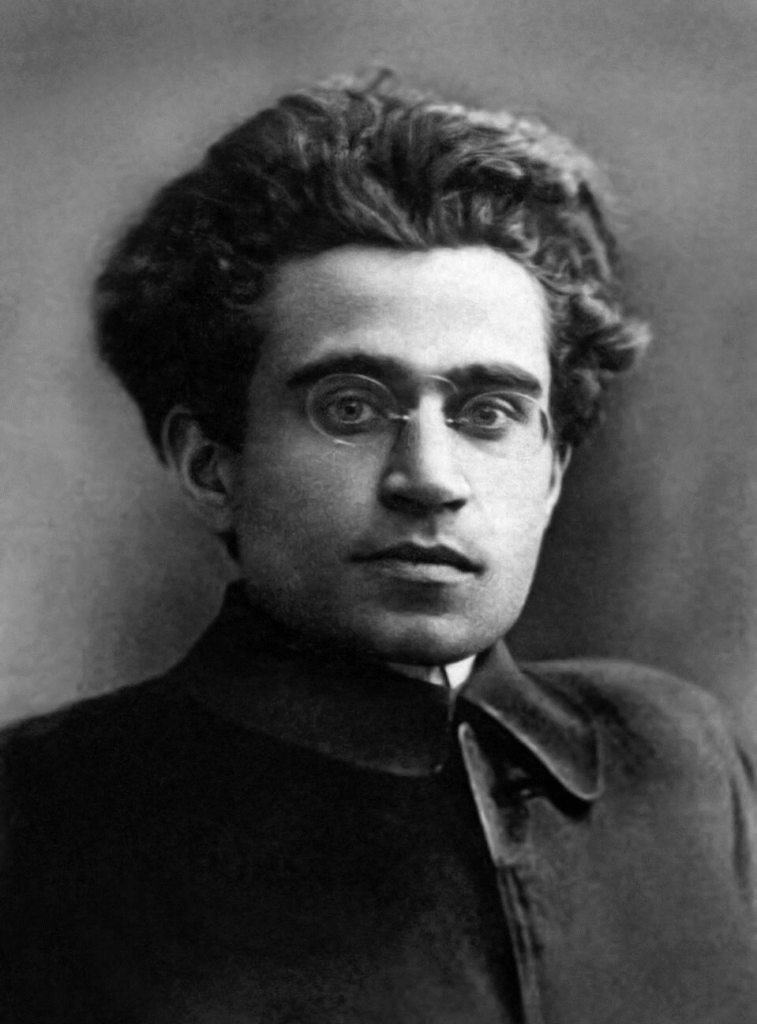
The stability of the Gramsci family was severely disrupted in 1897 when Francesco Gramsci was suspended from his administrative position, arrested, and sentenced to imprisonment on charges of alleged misconduct. Following this event, the family relocated to Ghilarza. During these years of economic hardship, Antonio suffered a serious childhood accident that reportedly contributed to the physical disabilities that affected him throughout his life, including spinal deformities and restricted growth.
Education and Intellectual Formation
At the age of eleven, after completing elementary education, Gramsci temporarily left school and worked in the local tax office in order to contribute to his family’s income. Despite financial difficulties, he continued his studies independently and eventually resumed formal education. His teachers quickly recognized his exceptional intellectual abilities, and he consistently achieved outstanding academic results.
Gramsci pursued further studies in Santu Lussurgiu before enrolling at the Dettori Lyceum in Cagliari. During this period, he became increasingly aware of the social and economic conditions of the working class. Living with his brother Gennaro exposed him to political discussions and socialist ideas that would later become central to his worldview. However, these years were also marked by material deprivation, deteriorating health, and recurring nervous disorders. His correspondence from this period reveals frustration over his family’s financial struggles and his father’s inability to provide consistent support.
A decisive turning point occurred in 1911 when Gramsci won a scholarship to the University of Turin. The scholarship, awarded to talented students from economically disadvantaged backgrounds in Sardinia, enabled him to continue his education despite limited resources. Among the candidates competing for the same scholarship was Palmiro Togliatti, who would later become one of the leading figures of the Italian Communist movement.
At the University of Turin, Gramsci enrolled in the Faculty of Letters and immersed himself in the study of literature, linguistics, philosophy, and social sciences. Despite suffering from chronic health problems, inadequate living conditions, and severe financial constraints, he excelled academically. He developed a particular interest in linguistics and even considered pursuing it as a professional specialization. Several professors, including the linguist Matteo Bartoli and the literary scholar Umberto Cosmo, became important intellectual influences and personal mentors.
Entry into Socialist Politics
Although Gramsci demonstrated considerable promise as a scholar, he gradually shifted his focus toward political activism. In 1915, he became actively involved in the Italian Socialist Party (PSI) and began a career in journalism. Through his articles and commentaries, he quickly established himself as one of the most perceptive and influential socialist writers in Italy.
As a journalist for the Turin edition of Avanti!, the official newspaper of the Socialist Party, Gramsci addressed a wide range of political and cultural issues. He also wrote theatre criticism and delivered lectures to workers’ educational groups. His intellectual interests extended beyond politics to literature, history, and revolutionary theory. During this period, he engaged deeply with the writings of Karl Marx and followed contemporary debates concerning socialism and social transformation.
The First World War significantly influenced his political outlook. While opposing nationalist militarism, Gramsci believed that the social and political upheavals created by the war could potentially contribute to revolutionary change. He increasingly argued that political transformation required not only economic struggle but also cultural and intellectual development among the working class.
Influence of the Russian Revolution
The success of the Bolshevik Revolution in Russia in 1917 had a profound impact on Gramsci’s political thinking. He viewed the revolution as evidence that socialist transformation was possible even under conditions that many Marxists had considered unfavorable. Although he maintained a critical perspective and did not accept every aspect of Bolshevik practice unconditionally, he became strongly committed to the broader project of international socialist revolution.
His growing emphasis on culture, education, and political organization reflected an attempt to adapt Marxist theory to the realities of modern industrial societies. These concerns would later become central themes in his theoretical work.
L’Ordine Nuovo and Revolutionary Activity
In 1919, together with Angelo Tasca, Umberto Terracini, and Palmiro Togliatti, Gramsci founded L’Ordine Nuovo (The New Order), a socialist journal that soon became one of the most influential publications of the Italian revolutionary left. The journal provided commentary on political developments in Europe, the Soviet Union, and the United States while promoting socialist culture and workers’ education.
During the years immediately following the war, Gramsci devoted much of his energy to supporting factory councils in Turin. He viewed these councils as institutions through which workers could gain direct experience in democratic self-management and collective decision-making. His involvement in these struggles enhanced his reputation as an important figure within the Italian socialist movement.
As political divisions intensified within the Socialist Party, Gramsci joined the communist faction that broke away in 1921 to establish the Italian Communist Party (PCI). Although he initially played a secondary leadership role, he quickly emerged as one of the party’s most insightful strategists and theorists.
Opposition to Fascism and Party Leadership
Gramsci was among the earliest political observers to recognize the threat posed by Benito Mussolini’s fascist movement. He repeatedly warned that the failure of socialist and democratic forces to unite against fascism would result in a devastating political defeat. His predictions proved accurate as Mussolini consolidated power throughout the 1920s.
Between 1922 and 1923, Gramsci served as the Italian Communist Party’s representative to the Communist International in Moscow. During this period, he developed important international political connections and deepened his understanding of revolutionary strategy.
In 1924, he was elected to the Italian Chamber of Deputies and subsequently became General Secretary of the Italian Communist Party. At the same time, his personal life underwent significant change. While in Russia, he met Giulia (Julka) Schucht, a musician and member of the Russian Communist Party. The couple married and had two sons, Delio and Giuliano.
Arrest, Imprisonment, and Final Years
The consolidation of fascist rule culminated in Gramsci’s arrest on 8 November 1926. Under Mussolini’s emergency legislation, he was imprisoned despite his parliamentary immunity. During his trial, a prosecutor famously declared that it was necessary to prevent “this brain from functioning” for twenty years.
In 1928, Gramsci received a sentence of more than twenty years in prison. Most of his imprisonment was spent in Turi Prison near Bari, where severe physical suffering compounded his already fragile health. Later, deteriorating medical conditions led to transfers to clinics in Formia and Rome, though he remained under constant surveillance.
Despite intense hardship, imprisonment became the most intellectually productive period of his life. With the assistance of his sister-in-law Tania Schucht and his close friend, the economist Piero Sraffa, he obtained books, journals, medicines, and other necessities. Their support enabled him to continue studying and writing under extraordinarily difficult conditions.
The Prison Notebooks and Intellectual Contributions
During imprisonment, Gramsci composed the works that would later become known collectively as the Prison Notebooks. These writings explored an extraordinary range of topics, including politics, philosophy, history, education, culture, literature, and linguistics. Although prison censorship restricted explicit political discussion, Gramsci developed innovative theoretical concepts that transformed Marxist thought.
Among his most influential contributions was the concept of hegemony, which refers to the capacity of dominant groups to maintain power not merely through coercion but through cultural leadership and the production of consent. He argued that political authority depends heavily upon the ability of ruling groups to shape values, beliefs, and common sense within society.
Other important concepts associated with his work include the organic intellectual, historical bloc, and national-popular culture. Through these ideas, Gramsci sought to explain the relationship between culture, ideology, political institutions, and social transformation.
Death and Legacy
After years of declining health, Antonio Gramsci died on 27 April 1937 as a result of a cerebral hemorrhage. His death followed a decade of imprisonment during which many of his medical conditions had gone inadequately treated.
Although much of his work remained unpublished during his lifetime, the postwar publication of the Prison Notebooks and his prison correspondence established him as one of the most important political thinkers of the twentieth century. His theories have influenced numerous disciplines, including sociology, political science, cultural studies, education, anthropology, history, and communication studies.
Today, Gramsci’s analysis of power, culture, ideology, and social change remains central to contemporary discussions of domination and resistance. His concept of hegemony, in particular, continues to provide scholars with a powerful framework for understanding how political authority is maintained and challenged in modern societies.
Timeline
| Year | Major Event |
|---|---|
| 1891 | Born in Ales, Sardinia, Italy (22 January 1891) |
| 1897 | Father Francesco Gramsci arrested and imprisoned; family moved to Ghilarza |
| 1902–1904 | Worked in the Ghilarza tax office to support his family after completing elementary education |
| 1904 | Returned to formal schooling after a period of employment |
| 1905–1908 | Studied in Santu Lussurgiu |
| 1908 | Enrolled at the Dettori Lyceum in Cagliari |
| 1908–1911 | Encountered socialist ideas and organized working-class movements in Cagliari |
| 1911 | Won a scholarship and entered the University of Turin |
| 1911 | Met future communist leaders including Palmiro Togliatti and Angelo Tasca |
| 1911–1915 | Studied humanities, linguistics, and social sciences at the University of Turin |
| 1913 | Joined the Italian Socialist Party (PSI) |
| 1915 | Left university before graduation and began a full-time career in socialist journalism |
| 1915 | Started writing for Avanti!, the newspaper of the Italian Socialist Party |
| 1917 | Influenced by the Russian Revolution; increasingly committed to revolutionary socialism |
| 1917–1918 | Promoted workers’ education and cultural organizations in Turin |
| 1919 | Co-founded L’Ordine Nuovo (The New Order), an influential socialist journal |
| 1919–1920 | Became a leading advocate of the Turin factory council movement |
| 1921 | Participated in the split from the Socialist Party and helped establish the Italian Communist Party (PCI) |
| 1921 | Elected to the Central Committee of the PCI |
| 1922 | Traveled to Moscow as the Italian representative to the Communist International (Comintern) |
| 1922–1923 | Lived in Moscow and developed international communist connections |
| 1923 | Met Giulia (Julka) Schucht, whom he later married |
| 1924 | Elected to the Italian Chamber of Deputies (Parliament) |
| 1924 | Became one of the principal leaders of the Italian Communist Party |
| 1924 | Birth of his first son, Delio |
| 1924–1926 | Served as General Secretary of the PCI |
| 1926 | Birth of his second son, Giuliano |
| 8 Nov 1926 | Arrested by Mussolini’s Fascist regime despite parliamentary immunity |
| 1927 | Held in Regina Coeli Prison and other detention facilities |
| 4 Jun 1928 | Sentenced to 20 years, 4 months, and 5 days in prison |
| 1928 | Transferred to Turi Prison, where he spent most of his imprisonment |
| 1929 | Began writing the Prison Notebooks |
| 1929–1935 | Produced the Prison Notebooks and extensive prison correspondence |
| 1933 | Death of his mother, Giuseppina Marcias |
| 1933 | Health deteriorated significantly due to prison conditions |
| 1933 | Transferred from Turi Prison to a clinic in Formia |
| 1935 | Moved to Quisisana Hospital in Rome under police supervision |
| 1935–1937 | Continued writing and revising theoretical reflections despite severe illness |
| 27 Apr 1937 | Died in Rome from a cerebral hemorrhage shortly after being formally released from prison |
| 1947 onwards | Publication of the Prison Notebooks and prison letters began |
| 1950s onwards | Gramsci emerged as one of the most influential political theorists of the twentieth century |
| Posthumous Legacy | Concepts such as Hegemony, Organic Intellectual, Historical Bloc, and National-Popular Culture became foundational in sociology, political science, cultural studies, and critical theory |
Key Phases of Gramsci’s Life
| Period | Phase |
|---|---|
| 1891–1911 | Childhood, poverty, and education in Sardinia |
| 1911–1915 | University education and intellectual formation in Turin |
| 1915–1921 | Socialist activism and revolutionary journalism |
| 1921–1926 | Leadership in the Italian Communist Party |
| 1926–1937 | Fascist imprisonment and creation of the Prison Notebooks |
| 1937–Present | Global intellectual influence and legacy |
This timeline highlights the major personal, political, and intellectual milestones that shaped Gramsci’s development from a poor Sardinian student into one of the most influential Marxist thinkers of the twentieth century.