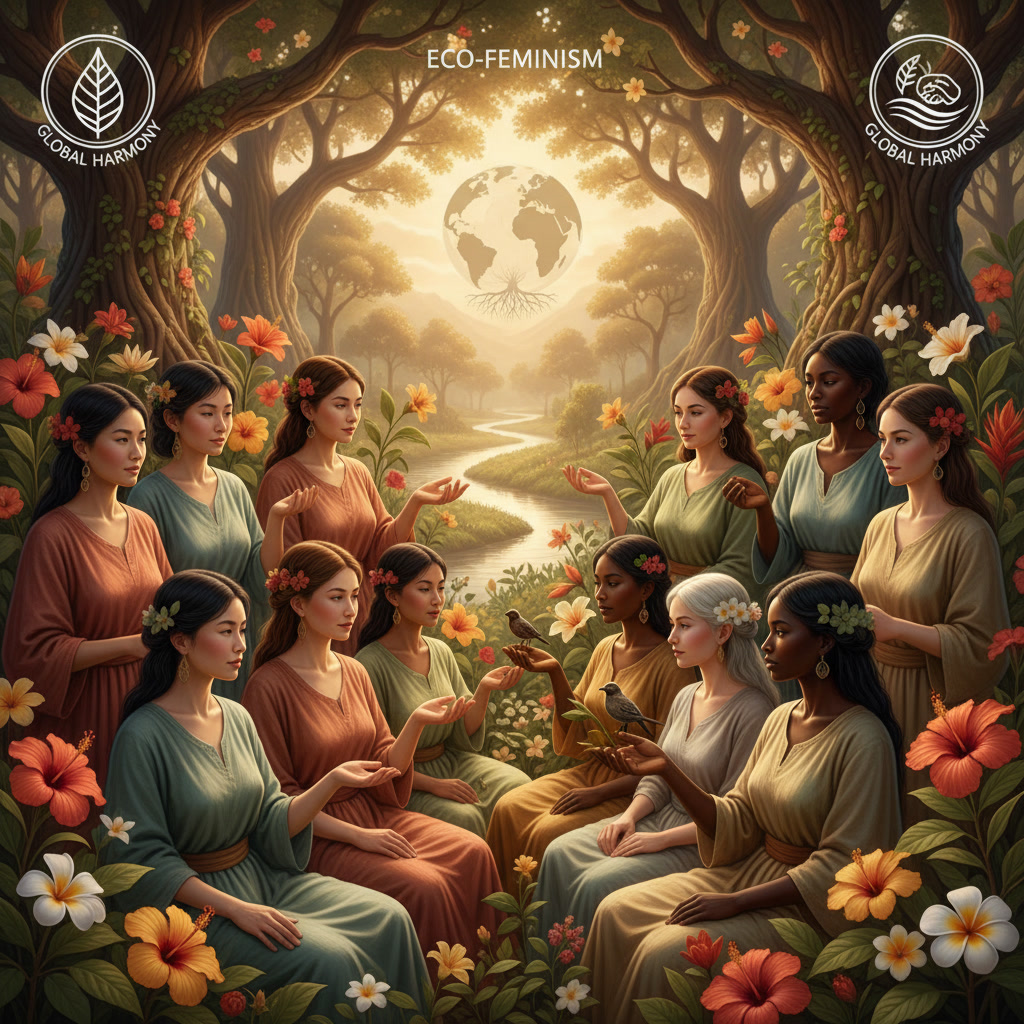
Eco-feminism is a branch of feminist thought that analyzes the parallel ways patriarchal values subordinate both women and the natural world. It applies feminist insights (e.g. equality, non-hierarchical structures, holistic worldviews) to environmental issues. As Britannica explains, ecofeminism “uses the basic feminist tenets of equality between genders… and a view of the world that respects organic processes, holistic connections” and adds “a commitment to the environment and an awareness of the associations made between women and nature”. In practice, ecofeminists emphasize how patriarchal culture “treats both nature and women” as inferior, showing how gender norms and ecological exploitation are interconnected. In short, ecofeminism sees the domination of women and the domination of nature as rooted in the same social logic, and it advocates an alternative worldview that values the earth as sacred and all life as valuable, including the principles of Eco-feminism.
Origins and Historical Emergence
The concept of ecofeminism originated in the 1970s amid second-wave feminism and the rising environmental movement. The term “ecological feminisme” was coined by French feminist Françoise d’Eaubonne in 1974 to signal women’s potential to lead an ecological revolution. In the United States and Europe, women’s studies scholars and activists began convening in the late 1970s to link feminist and environmental concerns. As Britannica notes, “the modern ecofeminist movement was born out of…conferences and workshops…by a coalition of academic and professional women” (late 1970s–early 1980s) to discuss combining feminism and environmentalism. These early ecofeminists observed that a long historical association of women with nature had justified the oppression of both. Women and nature were often portrayed as chaotic or irrational, needing control by the rational, ordering power of men. This “Up-Down” hierarchy – men/culture above women/nature – enabled patriarchy to exploit female labor and natural resources together. Early ecofeminist analysis therefore argued that the liberation of women and of nature were inseparable struggles: Rosemary Radford Ruether (a pioneer ecofeminist theologian) insisted that “all women must…end the domination of nature if they were to work toward their own liberation,” and called for women and environmentalists to unite against patriarchal hierarchies.
The principles of Eco-feminism continue to influence contemporary discussions on gender and environmental justice.
Through the 1980s ecofeminism grew from an academic discourse into a broader movement. For example, in 1987 feminist scholar Ynestra King’s popular Nation article “What Is Ecofeminism?” challenged readers to see the earth’s exploitation and women’s oppression as linked. King’s intervention helped expand ecofeminism’s reach: by the late 1980s, the concept had “grown both in support and philosophical scope,” reaching activists and intellectuals worldwide.
Major Ecofeminist Thinkers and Texts
Ecofeminist theory has been shaped by both feminist theorists and women activists. Key early figures include:
- Françoise d’Eaubonne (France) – Coined the term ecofeminism in Le Féminisme ou la Mort (1974), calling on women to lead an ecological revolution. She framed ecological crisis and women’s oppression as twin consequences of capitalist patriarchy.
- Carolyn Merchant (USA) – Historian of science. In The Death of Nature (1980) she traced the 16th–17th-century Scientific Revolution and capitalism as a logic that objectified both nature and women. Merchant argued that the “domination of women and of nature have shared roots in the logic of science and capitalism”. Her work pioneered an ecofeminist critique of Western science and industrialism.
- Maria Mies (Germany) – Economist and sociologist. In Patriarchy and Accumulation on a World Scale (1986) and co-authored Ecofeminism: Marxist Theory and Activism (1993, with Vandana Shiva), Mies articulated how global capitalism, colonialism and patriarchy intersect. She and Shiva highlight the double exploitation of women and nature under colonial capitalism, especially in the Global South.
- Vandana Shiva (India) – Physicist-turned-activist. A leader of environmental and agrarian movements, Shiva co-authored Ecofeminism (1993) with Maria Mies. She argues that Western “development” projects impose mono-crop economies and gendered labor divisions on colonized regions, causing a “feminization of poverty” and ecological degradation. Shiva’s ecofeminism is explicitly postcolonial and anti-globalization.
- Rosemary Radford Ruether (USA) – Feminist theologian. An early proponent of ecofeminism, she linked patriarchal religion and culture to the historical persecution of women and nature. Ruether urged that women must confront nature’s domination by patriarchal institutions.
- Susan Griffin (USA) – Writer and philosopher. Her 1978 book Woman and Nature explored how Western culture has “feminized” nature (and vice versa) to justify domination. Griffin’s work examined how women, animals and land were all categorized as “inferior” under male-dominated social orders.
- (Others): Numerous other thinkers have contributed, including eco-ethicist Karen Warren (feminist philosophy), vegetarian-ecofeminist Carol J. Adams, and activists like Bernadette Cozart (urban gardening), Lois Gibbs (Love Canal campaign), and Vandana Shiva and Maria Mies as noted above.
Each of these thinkers has linked gender relations to environmental issues through different lenses – whether historical, spiritual, economic or cultural – helping define the rich terrain of ecofeminist thought.
Strands of Ecofeminism
Ecofeminism is not monolithic; it encompasses several major strands with distinct emphases. These have often been categorized as radical (cultural/spiritual) and socialist/materialist (with variations like liberal or mainstream ecofeminism, vegan ecofeminism, etc.).
- Radical/Cultural Ecofeminism (including Spiritual Ecofeminism): This strand highlights a special affinity between women and nature, often invoking feminist spirituality. Cultural ecofeminists encourage linking women and the environment, arguing that women’s traditional roles (e.g. as nurturers and food-providers) and biological experiences (menstruation, childbirth, lactation) give women a “more intimate relationship with nature”. They celebrate values traditionally labeled “feminine” – compassion, care, interconnectedness – as vital ecological wisdom. Some draw on goddess imagery and indigenous spiritual practices, seeing the earth as sacred (the “feminine divine”) and calling for a reverence for all life. As Britannica explains, cultural ecofeminism has “roots in nature-based religions and goddess and nature worship” as a way to “redeem the spirituality of nature and women’s instrumental role in that spirituality”. Critics of this strand worry that it can essentialize women as inherently “nurturing” or romanticize nature.
- Socialist/Materialist Ecofeminism: Influenced by Marxist analysis, this strand insists that gender–nature links must be understood in terms of economic and social structures. Materialist ecofeminists argue that capitalist patriarchy creates intertwined oppressions: industrial and agricultural capitalism exploit both ecosystems and women’s labor or bodies. They focus on class, colonialism and global markets as key factors. For instance, Maria Mies and Vandana Shiva (1993) describe Western “maldevelopment” that destroys subsistence economies in Asia/Africa, creating poverty among women and ecological harm. In short, materialist ecofeminism contends that “socioeconomic conditions are central to the interconnected dominations of women and nature”. This approach underlies much ecofeminism in the Global South and among socialist feminists: it sees women’s liberation as linked to dismantling capitalism and imperialism as much as patriarchy.
Other distinctions include liberal ecofeminism, which seeks inclusion of women in mainstream environmental policymaking, and vegetarian/animal-rights ecofeminism, which links the liberation of animals with that of women and nature (Carol J. Adams’s work is notable here). Nonetheless, the main fault-lines remain between those who stress intrinsic women–nature parallels (radical/cultural) and those who stress social construction and materialist analysis (socialist/materialist).
Key Theoretical Debates
Ecofeminism has generated intense scholarly debate. Among the major controversies are:
- Essentialism vs. Social Construction: Early cultural/spiritual ecofeminism was criticized for implying that women have an “essential” affinity with nature. Critics (often poststructural and third-wave feminists) argued this reinforces the same stereotypes patriarchy uses: grouping all women as a homogeneous “feminine” category. As one critic put it, ecofeminist emphasis on women–nature links seemed “self-evident” but lacked rigorous proof and risked portraying women uniformly as nurturing. Ecofeminists responded that highlighting these links was sometimes a political strategy – a way to mobilize diverse women around common issues – rather than a biologically fixed claim. Over time most ecofeminists came to acknowledge both social construction and material conditions: Marxist-influenced writers insisted any “closeness” of women to nature must be understood in a historical, classed context. Today many scholars stress that gendered identities are shaped by culture and economy as well as biology, seeking a balance between these views.
- Spirituality vs. Secular Approaches: Ecofeminism’s engagement with spirituality has also been contested. Some ecofeminists (e.g. Starhawk, Charlene Spretnak, Carol Christ) have embraced Goddess spirituality and nature-based rituals as empowering and ecologically mindful. Others have been wary of mysticism. For example, feminist theologian Rosemary Ruether rejected mysticism but argued that spirituality and activism can indeed combine productively in ecofeminism. In contrast, social ecologist Janet Biehl criticized an over-emphasis on “mystical” female/nature imagery, warning it could distract from women’s actual material conditions. Thus a debate persists between valuing eco-spiritual revival (as re-enchantment with the world) versus focusing strictly on political-economic analysis.
- Global (Western vs. Non-Western) Perspectives: Ecofeminism has global dimensions, and scholars note important differences between Western and non-Western ecofeminist thought. Ariel Salleh and others observe that Western ecofeminism (especially in academia) was often where essentialist critiques arose, whereas many non-Western and socialist ecofeminists immediately grounded their analysis in colonialism, race and class. For example, Indian ecofeminists like Shiva have long emphasized Western development’s colonial violence and its gendered impacts, while environmental movements in Africa and Latin America highlight land rights, indigenous knowledge and postcolonial justice. This raises ongoing questions of how ecofeminist theory can respect cultural differences without imposing Western feminist categories, and how to integrate indigenous and Southern feminist voices.
- Intersectionality and Other Critiques: In recent decades ecofeminism has engaged with intersectional feminism, postcolonial theory, queer theory and disability studies. Ecofeminists have noted that race, ethnicity, class and sexuality intersect with gender in shaping environmental experience. For instance, some scholars emphasize that ecofeminism must advance “multiple axes of identity such as gender, race, and class” in relation to human–nonhuman nature. Critics from environmental justice and feminist care ethics have urged that any ecofeminist movement avoid racial or cultural paternalism. Others (such as disability scholars) have pointed out that gendered “nurturance” should not become a patronizing norm. Meanwhile, ecofeminism itself has incorporated newer themes: vegetarian ecofeminism (linking animal liberation with feminist-ecological ethics) and queer ecologies have emerged to question heteronormative assumptions in nature–culture debates.
Each debate has forced ecofeminists to refine their arguments. For example, many socialist ecofeminists now emphasize social construction: they “show clearly that women’s supposed intrinsic connection with nature is a socially constructed ideology,” rooted in capitalist patriarchy. By the 21st century, most ecofeminist scholars accept that gender is neither purely biological nor purely social, and they often use explicit intersectional and materialist frameworks to avoid the pitfalls of essentialism.
Ecofeminism, Environmental Justice, and Activism
Ecofeminism has always had a strong activist dimension, linking scholarship with on-the-ground movements. Classic examples include:
- Chipko Movement (India, 1970s): Rural women in Uttarakhand famously hugged trees to stop commercial logging. Ecofeminists highlight how Chipko activists saved thousands of hectares of forest and protested that deforestation “disproportionately harmed women” by increasing their burden of collecting fuelwood and by undermining local subsistence economies. Chipko helped illustrate the ecofeminist claim that women’s livelihoods and ecological health are deeply intertwined.
- Green Belt Movement (Kenya, 1977–present): Founded by Nobel laureate Wangari Maathai, this grassroots campaign mobilized African women to plant millions of trees against deforestation and land degradation. It explicitly framed environmental conservation as a feminist issue – one study notes that Maathai “wanted to achieve an ecofeminist movement” empowering women, promoting gender equality and land rights simultaneously. By reconnecting women to their land and knowledge, the Green Belt Movement embodies an ecofeminist praxis that combines ecological restoration with decolonization and women’s empowermen.
- Environmental Justice Campaigns (Global North): Many North American grassroots struggles against toxic waste and pollution have been interpreted through an ecofeminist lens. For instance, Lois Gibbs’s leadership in the 1978 Love Canal crisis (where chemical dumping caused harm especially to children and pregnant women) and various urban gardening projects by women of color have been seen as ecofeminist in spirit, emphasizing local control, health, and intersectional justice.
- Climate Justice and Global Networks (21st century): In recent years ecofeminism has re-emerged in climate movements. Journalist Katie Surma notes that at UN climate talks and beyond, a growing women’s climate movement explicitly links “aggressive resource extraction and attacks on women,” arguing that patriarchy and extractivism are root causes of climate change. Organizations like the Women’s Earth and Climate Action Network (WECAN) gather women leaders across continents to advocate climate policies centered on indigenous rights, land stewardship and gender equality. As one activist put it, climate justice requires taking down “systems…including patriarchy, capitalism and extractivism” – exactly the kind of systemic critique ecofeminism offers.
Through these and other movements, ecofeminist ideas have influenced policy discussions. Issues such as Gender and Environment in the United Nations, gender budgeting for green initiatives, and rights of nature legislation often reflect ecofeminist principles of relationality and justice. In sum, ecofeminism unites theory and practice: it has both a rich academic literature and a vibrant legacy of activism linking women’s rights with environmental protection.
Recent Developments and Future Directions
In the face of accelerating environmental crises, ecofeminism remains highly relevant and is experiencing renewed attention. Observers note that women’s leadership in environmental struggles has soared since the 2010s, and ecofeminist critiques are being applied to climate and social policy. A 2025 climate-news report observes that ecofeminist theory “is gaining traction and urgency” as women across the Amazon, Africa, Asia and North America mobilize against climate breakdown and gendered violence. Scholars and activists are integrating ecofeminism with cutting-edge issues: for example, they link gender justice to rights of nature laws, food sovereignty, and movements against environmental racism. Ecofeminism’s emphasis on holistic, non-hierarchical thinking also influences emergent ideas like feminist degrowth and circular economies, which challenge growth-oriented capitalism.
Looking ahead, ecofeminist theory is expanding in several directions. There is growing dialogue between ecofeminism and Indigenous environmental philosophies, highlighting traditional ecological knowledge and feminine deities in different cultures. Queer ecofeminism (drawing on queer theory) is interrogating gender norms in nature narratives, while critical disability studies are challenging stereotypes of who is seen as a “nurturer.” Intersectional ecofeminists continue to link climate policy with women’s rights, racial justice and labor rights. In global activism, ecofeminist networks (like the upcoming Women’s Assembly for Climate Justice) will likely push for systemic change at UN climate negotiations and in grassroots campaigns.
In summary, ecofeminism – as a theoretical framework and a movement – offers a distinctive lens on ecology, calling for dismantling patriarchal, capitalist, and hierarchical systems. By stressing the interdependence of social and ecological well-being, it provides a foundation for future scholarship and activism aimed at a just and sustainable world.