Introduction: Adorno and the Problem of Modernity
Theodor W. Adorno (1903-1969) occupies a distinctive and profoundly unsettling position within sociological and philosophical debates concerning the nature and consequences of modernity. His theoretical intervention represents a radical departure from the classical sociological tradition. Unlike foundational theorists such as Karl Marx, Émile Durkheim, and Max Weber, who, despite their substantial critiques of modern society, nevertheless identified progressive, emancipatory, or rationalizing possibilities within modern institutional arrangements, Adorno’s analysis is characterized by unrelenting pessimism, radical skepticism toward narratives of historical progress, and an uncompromising critique of modern rationality itself as a form of domination.
For Adorno, modernity cannot be understood simply as a developmental stage in social evolution, a transition from traditional to rational-legal authority, or even primarily as a mode of production. Rather, modernity constitutes a historically specific formation fundamentally characterized by structures of domination, processes of reification, institutionalized suffering, and the systematic suppression of human freedom and particularity—all operating paradoxically under the ideological banner of Enlightenment, reason, and progress. This profound contradiction between modernity’s emancipatory promises and its oppressive realities forms the central problematic of Adorno’s social theory.
Adorno’s reflections on modernity emerge from his broader engagement with Critical Theory, developed collaboratively within the Institut für Sozialforschung (Institute for Social Research), commonly known as the Frankfurt School. His intellectual trajectory was shaped decisively through collaboration with Max Horkheimer, and profoundly marked by the catastrophic historical experiences of the twentieth century: the rise of fascism and totalitarianism, the Holocaust and industrial genocide, two world wars, the consolidation of monopoly capitalism, bureaucratic state administration, and the commodification of culture. These historical ruptures compelled Adorno to confront a disturbing and theoretically challenging question: how could a civilization ostensibly committed to reason, scientific progress, and humanistic values produce barbarism, mass violence, and systematic dehumanization on an unprecedented scale?
Adorno’s response was theoretically radical and sociologically far-reaching. He argued that modernity itself—particularly in its dominant manifestation as instrumental rationality (Zweckrationalität)—contained within its fundamental structures the potential for domination and destruction. Rather than viewing fascism or Stalinism as aberrations from modernity’s trajectory, Adorno identified them as revelations of tendencies inherent within Enlightenment rationality itself. Modernity, instead of genuinely liberating humanity from myth, superstition, and arbitrary domination, had dialectically transformed reason into an instrument of control exercised over external nature, social relations, and human interiority. His critique of modernity thus extends far beyond analyses of economic exploitation, class conflict, or social differentiation; it targets the very epistemological and ontological structures of modern consciousness, interrogating the categories through which modern subjects apprehend and organize reality.
Dialectic of Enlightenment: Reason as Domination
Adorno’s understanding of modernity is theoretically inseparable from his critique of the Enlightenment project, most comprehensively articulated in Dialektik der Aufklärung (Dialectic of Enlightenment, 1944/1947), co-authored with Max Horkheimer during their wartime exile. In this foundational text, modernity is interpreted not merely as the practical application of Enlightenment ideals but as the historical realization and ultimate betrayal of Enlightenment rationality. The Enlightenment promised liberation from fear, superstition, myth, and arbitrary authority through the systematic application of reason, empirical science, and rational knowledge. The Enlightenment motto, as articulated by Kant, called for humanity’s emergence from self-incurred immaturity (Unmündigkeit). However, Adorno and Horkheimer famously and controversially argued that “enlightenment reverts to mythology” and that the Enlightenment project contained within itself a dialectical tendency toward its opposite—domination rather than liberation.
The core analytical problem, from Adorno’s perspective, lies in the historical transformation of reason into instrumental rationality—a particular form of rationality that reduces all phenomena to problems of calculability, technical utility, efficiency, and control. Enlightenment reason initially sought mastery over external nature to free humanity from material scarcity and natural necessity. However, this domination of nature dialectically extended to encompass human beings themselves, who became subjected to the same logic of calculation, standardization, and manipulation initially directed toward the natural world. Modern social institutions, economic systems, administrative bureaucracies, and structures of political power increasingly operate through processes of abstraction, quantification, standardization, and technical rationalization that treat human subjects as objects to be managed.
Modernity, in this sociological interpretation, is not merely rational but pathologically over-rationalized. Reason undergoes a process of formalization in which it ceases to interrogate substantive questions concerning ethical ends, normative values, or the good life, focusing instead exclusively on technical efficiency and optimal means. This represents what Horkheimer termed the eclipse of objective reason by subjective, instrumental reason. Adorno argues that this particular configuration of rationality systematically strips the phenomenal world of inherent meaning, qualitative distinctiveness, and ethical significance, transforming both objects and subjects into manipulable, exchangeable things—a process Marx identified as reification (Verdinglichung) but which Adorno extends beyond economic relations to encompass consciousness itself.
Human beings within modern social systems become increasingly reduced to replaceable, standardized units within bureaucratic hierarchies, economic production processes, and technological systems. Individuality, particularity, and non-identity are systematically suppressed in favor of abstract equivalence and functional substitutability. Unlike Weber, who analyzed rationalization as an inevitable but ambivalent historical process producing both technical efficiency and ethical dilemmas (the “disenchantment of the world”), Adorno viewed modern rationalization as fundamentally pathological and destructive of human flourishing. Weber’s metaphor of the “iron cage” (stahlhartes Gehäuse) of modernity described primarily institutional constraints; Adorno radicalized this analysis by demonstrating how modern domination operates not only through external institutional structures but also through internalized psychological mechanisms and cultural formations. Modern individuals internalize structures of domination, incorporating them into personality formation, desire, and self-understanding, thereby coming to experience unfreedom as normal, natural, and even desirable.
The Totality of Modern Society: Administered World and Social Integration
A central and theoretically distinctive feature of Adorno’s conceptualization of modernity is its emphasis on the totalizing character of modern social organization. Modern society does not present itself to subjects as visibly coercive or overtly dominating; rather, it appears as a coherent, rational, technically necessary, and historically inevitable system that forecloses possibilities for fundamental alternatives while naturalizing existing arrangements. Capitalism, bureaucratic administration, mass culture, technological rationality, and ideological legitimation form an interconnected, mutually reinforcing totality that penetrates and structures every sphere of social existence, from economic production and political governance to intimate relationships, leisure activities, and even unconscious desire.
Adorno decisively rejected reductionist or economistic explanations of domination based exclusively on ownership of productive means or exploitation of surplus value. While profoundly influenced by Marxian political economy and maintaining class analysis as essential, Adorno insisted that modern domination operates through multiple, intersecting mechanisms extending far beyond the economy. Domination in late capitalism functions through culture, language, communication, education, socialization, consumption patterns, and the organization of everyday life. Modernity comprehensively shapes not only material conditions but also the very categories through which individuals think, the structures through which they feel and desire, and the horizons within which they imagine alternative possibilities—or fail to imagine them.
This totalizing nature of modern social organization renders critique exceptionally difficult and problematic. Modern ideology does not function primarily through crude, externally imposed false consciousness that could be simply corrected through rational argumentation or consciousness-raising. Rather, ideology is materially embedded in social practices, institutional routines, consumption habits, cultural forms, entertainment, and even ostensibly “free” leisure time. The culture industry (discussed below) exemplifies this mechanism: individuals experience themselves as freely choosing among diverse cultural commodities while in fact reproducing standardized, pre-digested meanings that reinforce conformity to existing social arrangements. People subjectively experience freedom, choice, and individuality while objectively reproducing the very structures and relations that systematically constrain genuine autonomy.
Adorno’s theoretical pessimism derives substantially from this sociological insight: modern society integrates individuals so thoroughly and at such fundamental psychic and cognitive levels that even rebellion, critique, and ostensibly oppositional movements are frequently absorbed, neutralized, commodified, and ultimately transformed into mechanisms that stabilize rather than challenge the existing totality. Unlike Marx’s confidence in the revolutionary proletariat as the historical subject capable of transcending capitalism, or Durkheim’s faith in professional groups and moral regulation to restore social solidarity, Adorno identified no clearly available collective agent or institutional mechanism capable of fundamentally transforming modern structures of domination. This absence of an identifiable revolutionary subject represents a decisive break with classical sociological optimism.
The Culture Industry: Enlightenment as Mass Deception
One of Adorno’s most influential and empirically generative contributions to the sociology of modernity is his theorization of the Kulturindustrie (culture industry), a concept developed with Horkheimer to analyze the production, distribution, and consumption of cultural commodities in advanced capitalist societies. In modernity, particularly in its late-capitalist phase, culture ceases to function as an autonomous sphere of aesthetic creativity, critical reflection, or transcendent meaning. Instead, cultural production becomes industrialized, rationalized, standardized, and systematically organized for profit maximization and ideological integration.
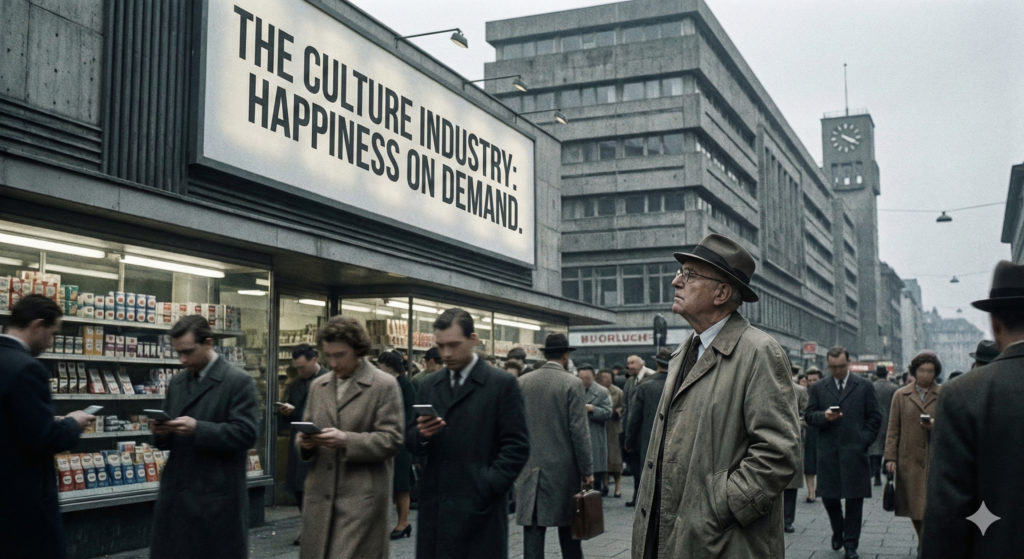
Modern mass culture—encompassing cinema, popular music, radio broadcasting, television programming, advertising, and subsequently digital media—creates a deceptive appearance of diversity, choice, and individuality while actually delivering highly standardized, formulaic products designed for passive consumption rather than active interpretation or critical engagement. Adorno argued that cultural commodities are deliberately engineered to produce predictable responses, manage desire, and foreclose critical reflection. Aesthetic pleasure becomes routinized, repetitive, and ultimately shallow, offering immediate gratification while preventing deeper satisfaction or genuine autonomy.
The culture industry performs crucial functions in stabilizing and reproducing modern capitalist society. By providing perpetual entertainment, distraction, and pseudo-individualized leisure, it systematically prevents individuals from confronting the fundamental contradictions, structural injustices, and unnecessary suffering characteristic of modern social organization. Human suffering is aestheticized and commodified; social conflict is trivialized or presented as individual psychological problems; and happiness becomes ideologically equated with commodity consumption rather than meaningful social relationships, creative activity, or political participation. The culture industry thus operates as a powerful mechanism of social control, arguably more effective than overt coercion precisely because domination is experienced as pleasure, freedom, and self-expression.
Importantly, Adorno did not reject culture, art, or aesthetic experience as such—a common misinterpretation of his position. His critique targeted specifically the industrialized mass production of culture as an instrument of domination and integration, not aesthetic experience per se. Adorno maintained a crucial distinction between autonomous art (discussed below), which resists commodification and challenges conventional modes of perception and understanding, and mass-produced entertainment, which reinforces conformity, suppresses critical consciousness, and reconciles individuals to existing conditions. Modernity, for Adorno, therefore constitutes not only an economic system or political structure but fundamentally a cultural condition that shapes consciousness, structures desire, and delimits imagination at the most basic levels of subjective experience.
Negative Dialectics: Critique of Identity Thinking
Adorno’s methodological response to modernity’s totalizing tendencies is articulated most systematically in Negative Dialektik (Negative Dialectics, 1966), which represents both a critique of traditional Western philosophy and an alternative model for critical social theory. Adorno rejected traditional philosophical systems—from Hegel through Husserl—that aim at synthesis, systematic closure, logical completion, or dialectical reconciliation of contradictions. For Adorno, such systematizing philosophical projects mirror and legitimize the totalizing, identity-imposing tendencies of modern society itself.
The central concept of negative dialectics is non-identity (Nichtidentität)—the insistence that concepts never fully capture, exhaust, or adequately represent the particularity of empirical reality. All conceptual thinking necessarily involves abstraction, classification, and subsumption of particulars under universal categories. However, modern instrumental rationality, in its drive for total comprehension and control, systematically denies this gap between concept and object, treating conceptual categories as if they were fully adequate to reality. This conceptual violence—the forced identity of concept and object—parallels and enables material violence against concrete particularity, difference, and uniqueness in social reality.
Adorno’s critique of modernity is therefore simultaneously a critique of modern epistemology and ontology. He argues that dominant modes of modern thought—positivism, instrumental reason, administrative rationality, commodity logic—systematically dominate their objects rather than genuinely understanding them in their specificity. True critical thought must resist this identifying impulse, remaining attentive to suffering, contradiction, and precisely what does not fit comfortably within existing conceptual systems and social categories.
Negative dialectics deliberately refuses to offer positive blueprints for future social organization or systematic theoretical alternatives to existing society. Such positive prescriptions would themselves constitute a form of conceptual domination, imposing identity and foreclosing genuine openness to otherness and non-identity. Instead, Adorno’s method keeps open the space for critique by persistently refusing premature reconciliation, false consolation, or affirmative closure. This methodological stance reflects the deep ambivalence and irresolvable contradictions of modernity itself—it mirrors rather than falsely resolves them.
This approach has significant implications for sociological theory and method. Adorno rejected both positivist empiricism, which reduces social reality to quantifiable data and causal laws, and abstract theorizing divorced from empirical particularity. His alternative—often termed “immanent critique”—involves identifying contradictions between society’s ideological self-presentation and its actual reality, between its universalist principles and its particularistic practices, demonstrating how society fails to live up to its own professed standards and values.
Modern Subjectivity and the “Damaged Life”
In Minima Moralia: Reflexionen aus dem beschädigten Leben (Minima Moralia: Reflections from Damaged Life, 1951), Adorno explores modernity at the micro-sociological level of everyday experience, interpersonal relationships, and individual consciousness. The subtitle’s reference to “damaged life” (beschädigtes Leben) encapsulates Adorno’s analysis of modern subjectivity: contemporary individuals live lives that are fundamentally damaged, distorted, and diminished by social conditions that systematically undermine the possibilities for genuine autonomy, authentic relationships, and human flourishing.
Modern subjectivity is characterized by fragmentation, insecurity, and deep contradictions. Individuals are ideologically encouraged and normatively expected to understand themselves as independent, autonomous, self-determining agents responsible for their own biographical trajectories—the neoliberal ideal of the entrepreneurial self. Yet simultaneously, their actual lives are profoundly structured, constrained, and determined by economic necessity, labor market demands, bureaucratic regulations, social competition, cultural conformity, and the internalized imperatives of self-commodification. This gap between ideological self-understanding and objective social determination produces anxiety, guilt, and various forms of psychological distress.
Even ostensibly private, intimate relationships are increasingly penetrated and structured by exchange logic and instrumental thinking. Adorno analyzes how romantic relationships, friendships, and family bonds are affected by commodification, strategic calculation, and the colonization of intimacy by market rationality. Love itself becomes instrumental; relationships are evaluated according to utility; emotional life is managed and optimized according to therapeutic discourses that themselves reproduce capitalist rationality.
Adorno fundamentally rejects the liberal-modernist narrative that modern individuality represents historical progress toward greater freedom and self-determination. Instead, he conceptualizes modern individuality as pseudo-individuality—a limited, standardized, and ultimately illusory form of selfhood produced by and functional for advanced capitalist societies. What appears as individual uniqueness is actually conformity to mass-produced cultural templates; what feels like autonomous choice is actually selection among predetermined, equivalent options; what is experienced as self-expression is actually the internalization and performance of socially mandated identity scripts.
This analysis distinguishes Adorno sharply from classical sociologists’ treatments of individuality. Durkheim interpreted modern individualism optimistically as a new moral foundation for social solidarity, grounded in the cult of the individual and professional ethics. Weber, while more ambivalent, nevertheless identified possibilities for meaningful ethical responsibility and value-rational action within modernity’s disenchanted landscape. For Adorno, by contrast, modern individuality is compromised at its very core, damaged by the same social totality that simultaneously produces and requires the ideology of autonomous selfhood. The modern subject is simultaneously demanded and impossible—both the ideological center of capitalist modernity and its primary casualty.
Adorno and Classical Sociological Perspective on Modernity
Situating Adorno within the canon of classical sociological theory illuminates both his distinctive contributions and his radical departures from mainstream sociological traditions. In comparison with the foundational triumvirate of Marx, Durkheim, and Weber, Adorno’s theory of modernity emerges as the most uncompromisingly radical, dialectical, and pessimistic.
Relationship to Marx: Like Marx, Adorno emphasizes capitalism, class domination, commodity fetishism, and reification as central features of modernity. Both theorists understand modern society as fundamentally structured by contradictions and view ideology as materially grounded rather than merely false ideas. However, Adorno decisively rejected economic reductionism, base-superstructure determinism, and the privileging of production over culture. He insisted that domination in late capitalism operates through multiple, relatively autonomous mechanisms including culture, administration, and subjectivity formation. Moreover, Adorno abandoned Marx’s confidence in the revolutionary proletariat and historical teleology, viewing the working class as integrated rather than radicalized by modern capitalism. Where Marx identified capitalism’s internal contradictions as sources of revolutionary potential, Adorno saw these same contradictions as stabilizing mechanisms.
Relationship to Weber: Adorno shares Weber’s focus on rationalization as modernity’s defining process and recognizes bureaucratic administration and instrumental rationality as central features of modern social organization. Both theorists analyze the disenchantment of meaning and the iron cage of rationality. However, Adorno radicalized Weber’s ambivalence into fundamental critique, rejecting the possibility of ethical responsibility or value-rational action providing meaningful alternatives within modernity. Where Weber saw rationalization as producing tragic dilemmas requiring ethical responses, Adorno viewed it as comprehensively pathological. Adorno also rejected Weber’s methodological individualism and value-neutrality, insisting instead on totality and normative critique.
Relationship to Durkheim: The contrast with Durkheim is perhaps most stark. Where Durkheim interpreted modern individualism as potentially providing new moral foundations for social solidarity, Adorno viewed modern individuality as pseudo-individuality—damaged and illusory. Durkheim’s concern with anomie and his faith in moral regulation, professional ethics, and collective consciousness as solutions to modern social problems find no counterpart in Adorno, who saw integration itself as pathological rather than solidarity as solution. Durkheim’s functionalism and emphasis on social cohesion represent precisely what Adorno’s critical theory opposed: affirmative sociology that legitimizes existing social arrangements.
Adorno’s theoretical stance represents a decisive break with sociology’s disciplinary optimism and its frequent complicity with administrative rationality. He challenged sociology to become genuinely critical rather than merely descriptive or functionally adaptive, to confront modernity’s darkest potentials rather than simply documenting social facts or facilitating social engineering.
Conclusion: Modernity Without Illusions
Adorno’s theorization of modernity remains profoundly unsettling precisely because it refuses comforting narratives of progress, development, or historical necessity. Modernity, in his rigorously dialectical analysis, emerges as a contradictory, violent, and deeply irrational process that ideologically promises liberation, autonomy, and human flourishing while systematically producing new, increasingly total forms of domination, reification, and suffering. Reason, culture, individuality, and freedom—the central normative ideals through which modern society legitimates itself—are revealed as deeply ambivalent, contradictory, and compromised by their entanglement with structures of domination.
Yet Adorno’s critique, despite its unrelenting negativity and apparent pessimism, is not nihilistic, cynical, or simply despairing. By insisting on the continuing necessity and possibility of critical thought, by developing negative dialectics as a methodology that refuses premature closure, and by maintaining attentiveness to particularity, suffering, and non-identity, Adorno keeps alive—however precariously—the possibility that modernity need not remain identical with itself, that existing reality is not exhaustive of possible reality. His thought embodies what might be called a pessimistic utopianism or utopian pessimism: the refusal of false hope combined with the equally strong refusal of resignation.
Adorno’s legacy challenges contemporary sociology to resist several perennial temptations: the temptation to accept modern society as technically inevitable or historically necessary; the temptation to celebrate cultural diversity while ignoring structural domination; the temptation to mistake formal freedom for substantive autonomy; and the temptation to practice affirmative, administrative sociology that serves existing power structures rather than subjecting them to immanent critique.
His work remains urgently relevant for understanding contemporary developments: the intensification of commodification through digital capitalism and platform economies; the integration of surveillance and algorithmic governance into everyday life; the colonization of intimacy and affect by market rationality; the incorporation of dissent and critique into branding and marketing; and the perpetuation of unnecessary suffering under conditions of unprecedented material abundance and technological capacity. These phenomena exemplify the continuing, indeed intensifying, relevance of Adorno’s analysis of the dialectic of enlightenment and the totally administered world.
Adorno’s critical theory ultimately calls for a sociology without illusions—one that confronts modernity’s darkest potentials and actualities without flinching, that refuses false reconciliation while maintaining commitment to human flourishing, and that practices relentless critique as the minimal ethical requirement for intellectual work under conditions of damaged life. This represents not pessimism but rather the difficult, necessary work of thinking against the grain of history without guarantees of success—what Adorno understood as the obligation of critical consciousness in a world that has not yet become what it could be.