Introduction
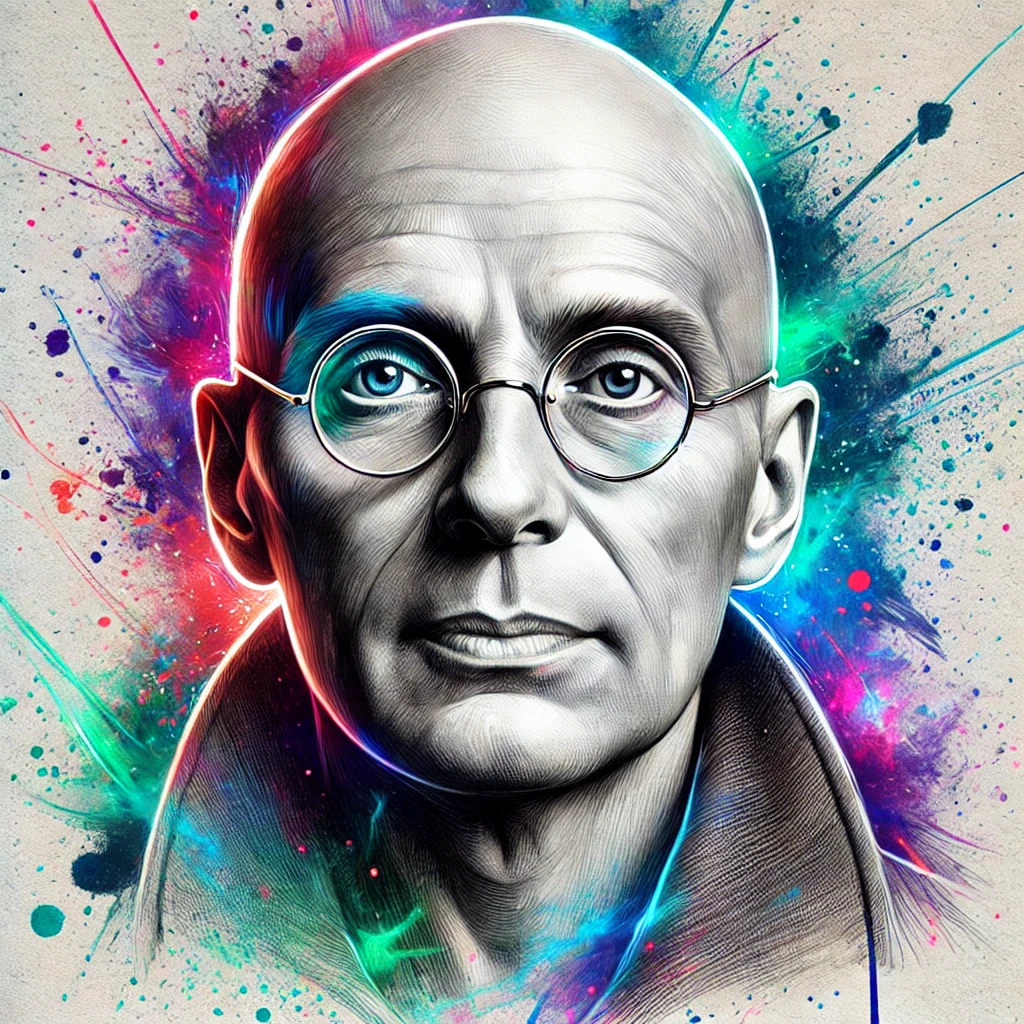
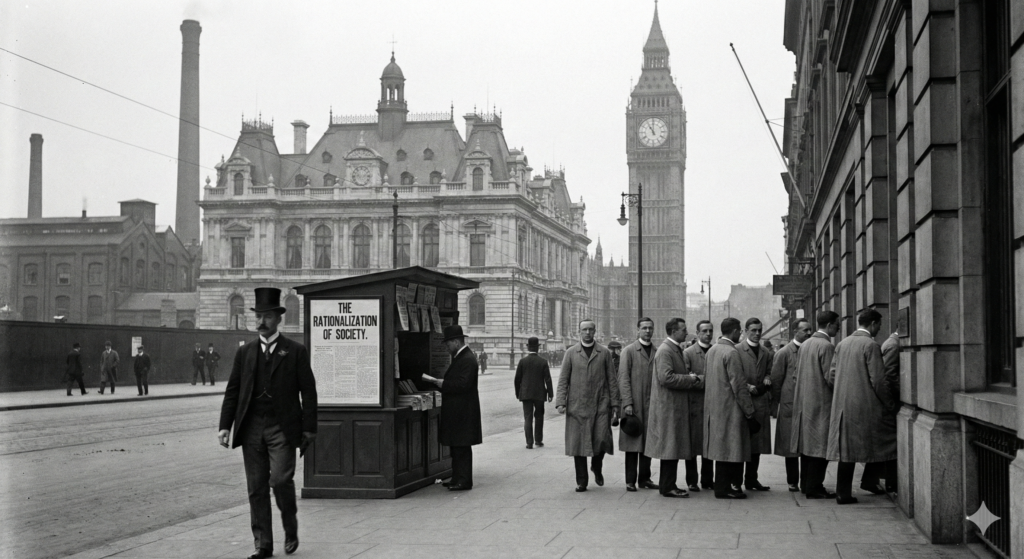
Max Weber (1864–1920) was a keen observer of the dramatic shift from traditional to modern society. Like his contemporaries Marx and Durkheim, he saw a “great transformation” unfolding, but he identified a distinct engine behind this change: rationalization. In Weber’s view, modernity means the gradual triumph of systematic, calculated reasoning over the unreflective habits and customs of the past. Where traditional social order depended on long-standing rituals or inherited status, the modern world organizes social action, beliefs, and institutions by deliberate planning, scientific knowledge, and rule-based management. This rational ordering extends into every domain of life – from how music is composed to how laws are made and how even fast-food restaurants manage their workflows. In short, Weber saw modern society as one in which people and organizations strive to “master all things by calculation,” replacing mystery and tradition with efficiency and predictability.
The Rationalization of Social Action
Weber analyzed how individuals act in society by identifying four ideal types of social action: affectional (driven by emotions), traditional (guided by ingrained habits), value-rational (motivated by deeply held beliefs or ideals), and instrumentally rational (focused on calculating the most efficient means to achieve goals). In the modern era, he argued, there is a clear shift away from purely emotional or customary actions toward more calculated, purposeful behavior. In other words, people increasingly ask “What is the most effective way to get what I want?” rather than “What have we always done?” or “What does my heart say?” This shift creates a skewed rationalization of society: instrumental rationality – the cost-benefit calculation geared to self-interested ends – tends to dominate life. By contrast, value-rational action, where one acts out of devotion to an idea or value regardless of profit or practical gain, becomes less common. For example, a businessperson focused on profits will meticulously analyze markets and resources (instrumental reasoning), whereas someone acting from duty might take steps regardless of personal gain (value-based reasoning). Weber feared that in modern times the former way of acting would increasingly crowd out the latter, leaving fewer decisions guided by ideals and more driven by efficiency or profit.
Modern Rational Capitalism
Weber saw capitalism not merely as an economic system, but as a hallmark of Western rationalization. Modern rational capitalism, he argued, is fundamentally different from earlier, more haphazard forms of trade or entrepreneurship (often called “adventure” or “robber” capitalism). The key difference is formal rationality: decisions are based on precise calculation and adherence to rules. Three core features characterize this modern capitalism:
- Rational Accounting: Businesses keep detailed records and base decisions on careful cost–benefit calculations. Profit, losses, inputs, outputs – everything is quantified so that resources can be managed scientifically.
- Legally Free Labor: Workers are free in the legal sense to sell their labor, and they contract with employers without personal bondage. Labor is a market commodity, enabling firms to hire and fire to maximize efficiency.
- Calculable Legal Systems: The state provides a predictable framework of laws and contracts. Property rights and business regulations are written down so entrepreneurs can plan their activities without fear of sudden seizure or unpredictable interference.
Weber famously traced the origins of this rational capitalist spirit to the Protestant Reformation, especially Calvinist teachings. Calvinism’s focus on predestination led believers to seek signs of salvation through hard work and frugality in a calling or vocation. This “ethic” taught that personal success in one’s work could be taken as a divine sign, which inadvertently encouraged disciplined economic activity. Over time, a systematic, ascetic approach to work spread, instilling habits like punctuality, savings, and investment. However, Weber stressed that once modern capitalism was established, it became a self-sustaining, impersonal machine. The “spirit” of religious devotion that helped launch capitalism was no longer needed; capitalist enterprises now function automatically under the logic of profit, as if driven by an endless gear—what Weber described as an “iron cage” of capital that people must serve. In this sense, capitalism becomes an objective system to which everyone—capitalist or worker—must submit, regardless of personal beliefs.
Bureaucracy and Rational-Legal Authority
Another signature of modernity, for Weber, is the rise of bureaucracy and rational-legal authority. In traditional societies, people obey authority because of customs, divine right, or personal loyalty—think of a king who rules by ancient lineage or a tribal elder who leads by tradition. Modern societies shift to rational-legal authority, where power rests on formal rules and positions rather than on individuals. Bureaucracy is the purest example of this shift. A bureaucracy is an organization structured by clear hierarchies and impersonal rules, staffed by technical experts and specialists. Decisions are made according to written procedures, not the whims of a leader.
This bureaucratic model is extremely efficient at accomplishing complex tasks: it enables large-scale projects (like building railways or administering social services) because everyone knows exactly what to do and how. However, Weber warned of its dark side. A bureaucratic system can become a “structure of domination” that is escape-proof: once people are inside the system (as workers or citizens), they are bound by its rules day and night. The individual is reduced to a cog in a machine of offices and forms. Weber feared this leads to the dehumanization of social relations. People begin to think only in terms of roles and procedures; creativity and personal initiative get sidelined. Bureaucracy demands conformity and technical expertise, and it favors “specialists without spirit” who follow rules to the letter. Thus, the advance of bureaucracy, Weber argued, might produce many orderly administrations, but also a generation of “little men” who crave only stability and order. In sum, modern rational authority provides reliability and efficiency, but it also risks stripping away spontaneity, emotion, and individuality from public life.
The Pathologies of Modernity
Science, Disenchantment, and the Crisis of Meaning
Science and technical reason are at the heart of Weber’s modernity. Scientific advances have contributed to rationalization by explaining the world through cause and effect, enabling humans to control nature and society like never before. However, Weber noted, this scientific worldview comes with a cultural cost: disenchantment. In earlier times, people believed in spirits, miracles, and sacred meanings behind natural phenomena. Modern science treats the world as a system of calculable laws, stripping away mysteries. As traditional sources of wonder and meaning vanish, individuals can feel that the world has become “disenchanted” – empty of magic or transcendence.
Crucially, Weber emphasized that science is effective at telling us what is but powerless to tell us what ought to be. Science can clarify choices by predicting outcomes, but it cannot arbitrate between values. He put it starkly: a purely rational, scientific approach to life leaves us with meaninglessness in an existential sense. Since science does not provide moral truths or ultimate purpose, people are left floating between conflicting value systems. Modernity brings value pluralism – a kind of “absolute polytheism” of belief. Different ideologies, religions, and lifestyles compete, but none can claim universal authority. In this “plurality of warring gods,” individuals must create their own meaning. Weber believed that in the face of disenchantment, each person must decide for themselves which ideals or causes to follow, because society no longer offers a single, unifying narrative. This can be empowering, but also anxiety-inducing: modern people must choose their own gods in a world where old certainties have been shattered.
The Iron Cage
Weber used the powerful metaphor of the “iron cage” (eisen Käfig) to describe the trap of modern life. As rationalization deepens, people risk becoming imprisoned by systems they themselves have built. Two key aspects of this cage are particularly striking:
- Masterless Slavery of Capitalism: In a rational capitalist market, there is no single human master telling you what to produce or buy. Instead, the impersonal “laws of the market” reign. Weber called this a form of “masterless slavery.” Everyone — employers and workers alike — must obey the market if they want to survive economically. For example, a factory owner who refuses to adopt new production methods or make a profit-efficient decision can quickly lose business and fail. Even though the market is an abstract force rather than a person, it demands obedience. In modern capitalism, then, freedom from a human boss can coincide with a new kind of enslavement to the system itself.
- The Bureaucratic Self: Bureaucracy’s reach means our public and private lives become saturated with rules. Weber worried this leads to what he called the “bureaucratic personality.” Such a person prizes order above all else and shuns anything unpredictable or rebellious. If everyone becomes like that, society becomes a dull, mechanical place. Young people, he thought, might lose the ambition or creativity needed for leadership; instead, they become content to follow routine. In the end, the iron cage of bureaucracy and commerce results in depersonalization: people act less as free individuals and more as functionaries.
Thus, the pathology of modernity is a paradox: the very tools that empower modern life can turn it into a rigid, confining maze. The “shell as hard as steel” of bureaucracy and capitalist organization allows no escape into spontaneous or meaningful existence. Weber lamented that this iron cage represents the dark side of progress.
The Individual’s Response: The Ethic of Personality
Weber was clear that there are no easy societal fixes for the dilemmas of modernity. Unlike Marx, he did not foresee a revolutionary end to capitalism, nor did he imagine a return to a sacred communal order. Instead, Weber offered a vision of how an individual might live a meaningful life within the iron cage. He called this the development of one’s ethic of personality. In essence, each person must become their own source of values and purpose. Weber outlined a kind of personal program for this:
- Make a Decisive Choice: First, an individual must consciously choose the core values or beliefs that will guide their life. This means not drifting along with the latest trend or ideology, but deliberately deciding what is worth committing to – whether it’s a political cause, a work vocation, an artistic ideal, or a spiritual path.
- Practice Self-Discipline: Once values are chosen, the individual must exert discipline to follow them. This involves subordinating momentary desires or impulses to the higher goals one has set. For example, a person who values scholarly truth must cultivate habits of study and reflection, even when it is difficult or against the grain of a system that rewards conformity.
- Commit to a Vocation: Finally, Weber emphasized the importance of a vocation or calling (Beruf). This means finding a role or profession in which one can take responsibility and express one’s chosen values through daily work. In modern society, one can still experience a sense of freedom and purpose through dedicated service in a field – whether as a scientist, teacher, artist, or community activist. In Weber’s view, earning one’s living in a conscientious way can itself be a way of asserting individuality.
By following this ethic of personality, an individual carves out a small space of autonomy and meaning in an otherwise impersonal world. Weber believed that even if society is dominated by rational systems, a committed person can still act with integrity. It won’t free anyone from modern pressures, but it at least helps avoid aimlessness.
Conclusion: Realpolitik and “Gloomy Realism”
In sum, Weber’s view of modernity is one of tragic realism. He rejected the notion – common since the Enlightenment – that progress automatically brings moral improvement or happiness. Instead, he predicted that the key features of modern society (rationality, bureaucracy, capitalism) would remain deeply entrenched, whatever the future. Weber famously referred to himself as a “gloomy old stick” (a translation of pessimist) because he felt inequality, power struggles, and the iron cage were inescapable aspects of modern life. Unlike Marx or Durkheim, who hoped for a qualitatively new society (like socialism or a harmonious order), Weber thought any future will be just another variation of our current rationalized world. The “fate of our times,” he warned, is that we live in cages of our own making. Thus, finding freedom or meaning is not a matter of changing society at large, but of the individual striving to preserve their own values and humanity amidst it all.
Weber’s analysis thus leaves us with a sobering perspective: modernity offers incredible powers of science and organization, but it also creates “little men” and a world where everything is dominated by calculation. The best we can hope for, in Weber’s eyes, is to acknowledge this reality – and then, at a personal level, live intentionally. In this way, even within the iron cage, we seek to keep the flame of human spirit alive.