Introduction
Karl Marx (1818–1883) witnessed the great transformation from traditional feudalism to modern industrial society. Unlike many of his contemporaries, Marx identified the capitalist mode of production – not just the machinery and factories – as the defining feature of this new era. He saw industrial modernity as a transitional phase or even the final stage of human “prehistory” on the way to a truly human, classless society. Marx documented the horrific human costs of industrial capitalism, yet he also recognized its revolutionary energy and the unprecedented heights of productive power it unleashed – often calling it capitalism’s “great civilizing influence.”
The Economic Foundations of Society
Central to Marx’s analysis of modernity is historical materialism – the theory that the economic organization of society largely determines its character and development. Marx described society using a two-level model. The infrastructure (or economic “base”) consists of the forces of production (technology, tools, factories, raw materials, labor skills) and the relations of production (who owns the means of production, and how people are divided into classes). Built upon this base is the superstructure, which includes all the political, legal, and cultural institutions of society, as well as the prevailing ideologies and belief systems. For Marx, material life shapes ideas, not the other way around. He summarized this with the slogan: “life determines consciousness” – meaning that the way people make a living ultimately shapes their politics, culture, and thinking.
Capitalism as a Modernizing Force
Marx argued that capitalism is a uniquely dynamic system that incessantly revolutionizes production and society. The capitalist class (the bourgeoisie) is driven by an “unlimited mania for wealth” and forced by the “coercive laws of competition” to constantly upgrade technology and expand markets. The result is a whirlwind of modernization with several key effects:
- Urbanization: Capitalism “subjects the country to the rule of the towns.” It creates enormous cities, drawing masses of people into industrial urban centers. Villages shrink as factories rise; workers crowd into cities for jobs. Marx noted that capitalism completes the “victory of the town over the country,” rescuing large populations from what he called the “idiocy of rural life.”
- Globalization: Modern industry establishes a truly world market. Capitalists, needing ever-bigger markets, spread their production and trade everywhere. Nations become economically interdependent. No country can remain purely feudal or self-contained; all end up tied into the “bourgeois mode of production.” As Marx described, bourgeois production forces every country to adopt its methods, giving the world a cosmopolitan character. Old national industries are destroyed or replaced, and trade networks bind distant regions together.
- Productivity: Within a single century, capitalism has unleashed more productive power than all previous centuries combined. Advances in science and technology drive vast increases in output. Under capitalism, nature itself is harnessed as raw material and energy to serve industry. For the first time, a single nation can produce far more material wealth – from steel and railroads to consumer goods – than ever before in human history.
However, Marx stressed that this modernizing drive is also destructive. As capitalists revolutionize production, they tear down traditional social forms. Old customs, local communities, and feudal hierarchies are “pitilessly torn asunder.” In Marx’s famous phrase, “all that is solid melts into air”: every fixed way of life is uprooted by the churn of the market. Kinship ties, religious beliefs, and long-standing institutions become obsolete as capitalism demands raw material, labor, and markets. Thus, capitalism brings unprecedented progress – but progress that constantly uproots and unsettles society.
Exploitation and Alienation in Capitalist Modernity
Marx insisted that the real meaning of modernity lies in the hidden abode of production – the factories and workplaces behind the marketplace. On the market, transactions look free and equal: buyers and sellers meet as nominally independent individuals. Marx called this surface world a “very Eden of the innate rights of man,” where freedom and equality appear to reign. But once we step inside the factory, a darker reality emerges. There he identified three central ills of capitalist modernity:
- Exploitation: Capitalism enriches the owners of capital by exploiting the labor of workers. In a factory, workers produce far more value during the day than the wages they receive. The capitalist pays wages to hire labor-power, but then appropriates the surplus product as profit. In Marx’s words, the creation of wealth under capitalism happens “in contradiction to and at the expense of the individual human being.” In short, profit comes from unpaid labor. The very expansion of wealth thus requires extracting more work from people than they are paid for.
- Immiseration: Capitalism tends to keep workers poor and dependent. Even if wages rise nominally over time, workers remain a “mere means of production.” Any gains can be eroded by inflation, longer hours, or higher living costs. The worker is squeezed by the very system that claims to improve productivity. Under capitalist discipline, workers lose the skills and autonomy they once had. As Marx described, modern industry “distorts the worker into a fragment of a man.” A person’s identity and creativity are reduced to a single function – laboring for a wage. In practice, workers become no more than cogs in the machine: stripped of trade secrets or craftsmanship, and treated like “an appendage of a machine,” to use Marx’s vivid image.
- Alienation: Wage labor alienates human beings in multiple ways. First, workers are alienated from the product of their labor: the goods they make belong not to them but to the capitalist. A factory worker might spend hours building a machine, but that machine goes to the owner’s profit – the worker never really enjoys its fruits. Second, workers are alienated from the act of production: they have no say in how their labor is performed. Work is dictated by management, machinery, and pace, not by the worker’s own needs or creativity. It becomes monotonous and tedious – even “a torment,” in Marx’s language. Third, workers are alienated from their species-being: capitalism prevents people from realizing their full human potential. Labor under capitalism serves survival or profit, not self-expression; people are not able to develop their talents and creativity at work. Fourth, social relations become competitive and impersonal. Capitalism encourages individuals to be selfish and to view others as rivals. Community and solidarity weaken as each person is driven by “naked self-interest” or, as Marx said, by the law “each looks to himself only.” In this way, even our relations with friends, family, and neighbors can become strained by economic pressure.
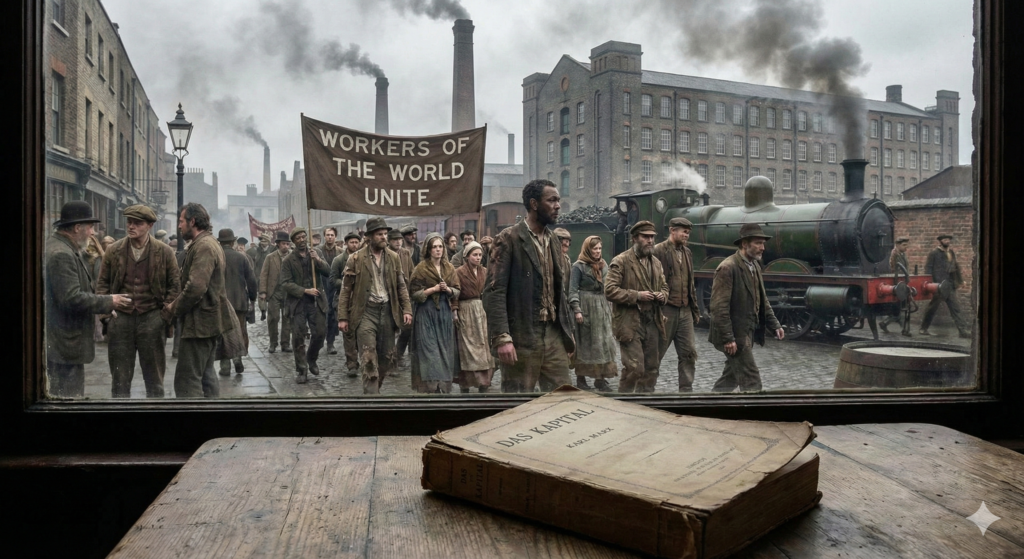
In short, Marx saw capitalist factories as places that turn people into objects. The very tools and machines meant to serve human needs end up controlling human lives. Workers feel powerless and empty in their labor. As Marx observed, the more wealth capital accumulates, the more it piles up misery and alienation for those who make it. The growth of modern industry thus comes at the price of deep social suffering.
The Political Contradiction: The State and True Democracy
Marx also noted a contradiction built into modern capitalism between politics and economics. In law and politics, individuals are formally equal: under the bourgeois constitution, people enjoy equal rights and (in theory) universal suffrage. But in reality they remain deeply unequal. A person can be “equal in the heaven of the political world” yet “unequal in the earthly existence of society.” In other words, while laws treat everyone alike, the material conditions of life (access to property, education, jobs) are very different. Formal political freedom can coexist with real economic domination. Political emancipation – granting civil rights – leaves intact the class structure that determines daily life.
Marx was sharply critical of the modern state for this reason. He portrayed the bourgeois state as a parasitic body that stands above society, serving the interests of the ruling class. It operates through its bureaucracy, courts, police, and army, often defending the status quo of wealth and property. To Marx, even a representative parliament simply acts as “a committee for managing the common affairs of the whole bourgeoisie.” In practice, the state’s role is to stabilize the capitalist system. Even if elections exist, the government often only rubber-stamps policies that favor capital. In fact, Marx himself said that a “free state” with voting rights can still leave ordinary people unfree, since their economic dependence remains.
So how could democracy ever be real under capitalism? Marx proposed a much more radical model of democracy once the working class was in power. He sketched out what he called true democracy, which would radically democratize government and society:
- Abolition of the state as a separate power: The state apparatus would eventually dissolve into the community. Instead of a standing government ruling over society, political power would be exercised directly by the people. The offices of the state – from judges to administrators to soldiers – would no longer form an isolated class. In Marx’s ideal, these functions would become routine matters of the whole community. The sharp division between rulers and ruled would disappear once class antagonisms are removed.
- Universal participation: Every adult member of society would have the right to vote and to stand for office. Marx insisted on the “greatest possible universalization of voting.” In practice, this means active and passive suffrage for all – no restrictions by property, wealth, gender, or background. Elections would be frequent, with any citizen able to be chosen for public roles. In such a system, the legislature would truly represent the will of the entire people, and all communities and workplaces would send delegates.
- End of professional politics: Genuine democracy would have no career politicians. Instead, ordinary citizens would periodically serve short terms in public office. Marx praised the example of the Paris Commune (1871), where public officials were elected from workers, paid the average worker’s wage, and could be recalled at any time. In Marx’s vision, public roles rotate among citizens: people take turns running their factories, towns, and organizations, then return to their regular lives. He spoke of “democracy without professionals.” In this way, governance becomes an extension of everyday life, not a special separate realm.
In Marx’s view, these changes would begin to bridge the gap between formal political rights and real social power. The same working people who run the economy would also directly run their government. Local councils of workers and communities would manage production, distribution, education, and administration. In such a socialist democracy, there would no longer be a distinction between the political world and everyday life. “Society would rule itself,” to use Marx’s phrase, and the alienating division between citizen and worker would be overcome.
The Future: Modernity Beyond Capitalism
Marx believed that capitalism, powerful as it seems, contains the seeds of its own demise. It is a historical stage that creates the conditions for a superior society. By overthrowing feudal lords and building machinery, capitalism has built immense productive forces and a unified modern working class. It has spread literacy, science, and technology to the masses; it has made people aware of their shared class position. Crucially, capitalism has made millions into urban wage-laborers with common interests. In Marx’s view, this is capitalism’s historical mission: to complete the prehistory of human society by developing industry and forming the proletariat on a world scale.
What comes after capitalism? Marx envisioned a qualitatively new society: Socialism (eventually evolving into full Communism). In this future, the achievements of modernity would be preserved but reoriented to human freedom. Key features include:
- Workers’ control of the means of production: The factories, mines, machines, and land built under capitalism would become the collective property of the producers. Instead of private owners, the workers themselves would democratically manage the economy. The instruments of labor would be under “the joint control of the producers.” In practice, this means cooperative ownership and planning: workplaces would be run by elected committees of workers, and large industries might be overseen by federations of those committees. The profit motive would vanish; production would serve social needs under workers’ guidance.
- Shorter working day and expanded freedom: With modern technology, society could produce its goods with much less human toil. Marx foresaw that under socialism the workday would shrink dramatically, opening a vast “realm of freedom.” People would spend much more time on education, arts, leisure, and democratic participation. In this vision, labor would become more voluntary and fulfilling – a dignified activity rather than a trap. Most hours of life would be free from necessity; individuals could pursue creative and social endeavors, free to develop their talents.
- Production for human needs and self-realization: The aim of production would shift away from profit and toward human development. Instead of producing commodities for exchange, society would produce goods and services to meet everyone’s needs. In Marx’s words, each person would finally be able to work with the purpose of self-fulfillment. He envisioned a society where distribution followed “From each according to his ability, to each according to his needs.” In full communism, people would contribute what they can and take what they require. Work would become an expression of individual and collective human creativity, not alienated labor.
- End of class antagonisms: As the working class abolished private capitalist property, class divisions would disappear. There would be no owners exploiting workers. With no class conflict to manage, the state as an independent entity would begin to “wither away.” Political power and resources would be shared equitably, rather than controlled by a few. In such a society, all individuals would truly be free and equal in both the political and economic sense.
For Marx, the end of capitalism is not the end of history – far from it. He believed that capitalist collapse would mark the beginning of genuine human history. The productive forces and social knowledge accumulated under capitalism would then be freely used by all. Instead of masters and slaves, society would have masters of none but own destiny: every person would become a master of their own fate. The cities, machines, and networks of modernity would not be discarded but turned toward social ends. Under socialism, the very industry and science of modernity would fully serve society.
Conclusion
Marx’s view of modernity is deeply dialectical. On one hand, he saw that capitalism had been extraordinarily creative: it transformed societies, unleashed scientific and technological progress, and built vast material wealth. It swept away feudal customs and unlocke d human capability on a grand scale. But on the other hand, he knew this very system is full of contradictions: it generates great wealth and great misery at the same time. Modern capitalism produces abundance for some and squalor for others; it builds railroads and slum housing hand in hand. For Marx, these contradictions are not bugs but features of the capitalist system’s logic.
In summarizing Marx’s overall perspective, one can say he regarded modern capitalist society as a revolutionary chapter that contains both the solution and the problem of human development. Capitalism creates the industry and the international working class needed for a new society (the solution), but it does so through exploitation and class struggle (the problem). Marx believed that these conflicts would intensify until the working class became conscious of its interests and overthrew capitalism. Only then, he argued, could society reorganize production for human needs instead of profit.
Marx saw the present as a way-station on a longer journey. Modern capitalism is both the culmination of past development and the threshold of a new era. In Marx’s vision, history’s goal – a truly free and cooperative society – lies beyond capitalism. He believed that once the contradictions of modernity are resolved, modern industry and globalization will serve human emancipation. Thus, modernity in Marx’s view is full of both creative promise and conflict: it contains within it the seeds of a socialist future, where people become the masters of their own destiny, no longer oppressed but fully human.