In the history of philosophy, Immanuel Kant’s Critique of Pure Reason serves as bedrock for modern understanding of the social world. He argued that Reason has several limitations, which is why it is enough to understand the social world through our mind or reason alone. Kant’s exploration of Noumena and Phenomena is crucial for this understanding.
If you’ve been reading the text, you’ll notice Kant is doing something a bit counter-intuitive. Usually, when we think about “errors” in thinking, we blame ourselves, like we weren’t paying attention, or we didn’t have enough data. But Kant is suggesting something far more radical. He’s saying that the “errors” are actually baked into the hardware. It’s not that you’re using your reason poorly; it’s that reason, by its very nature, has a boundary it’s constantly trying to hop over. Let’s understand his distinction: Noumena and Phenomena.
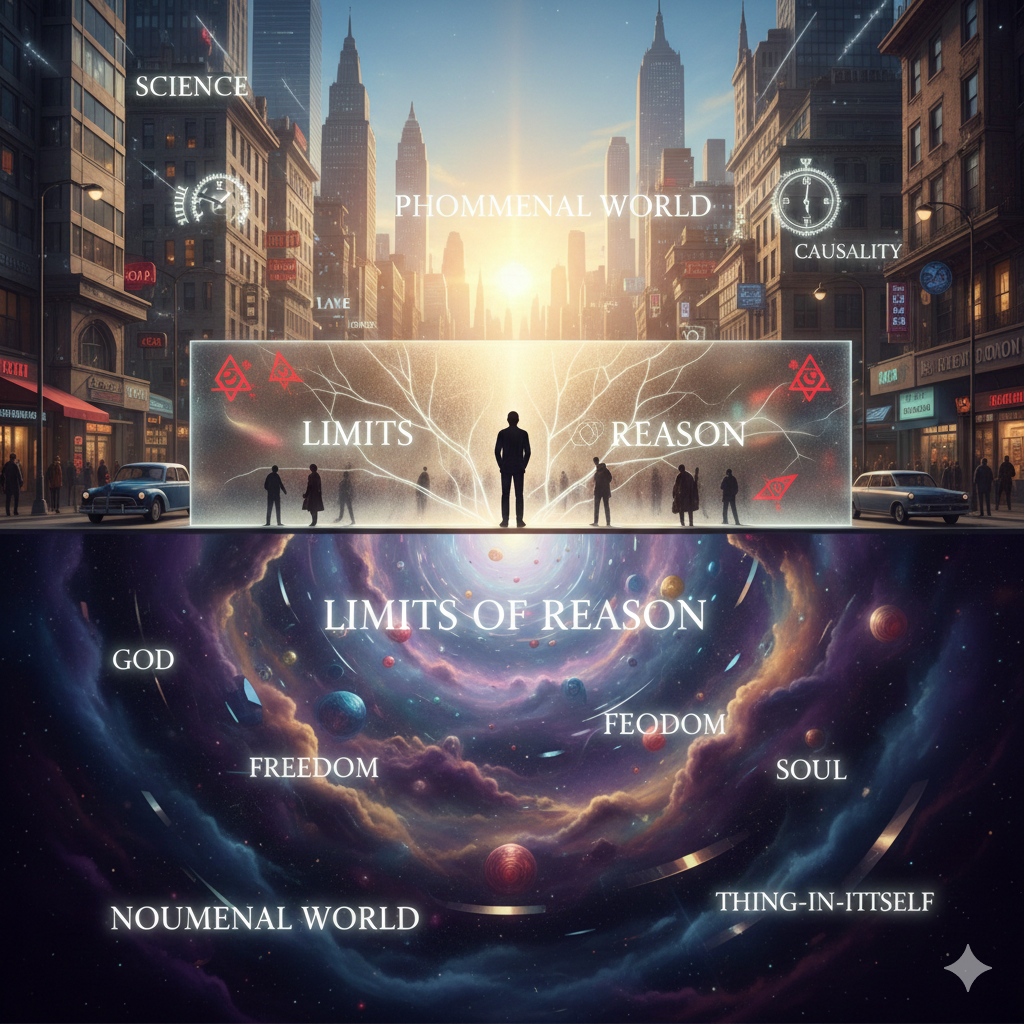
The World of “Appearances” (Phenomena)
First, look at the desk in front of you. To you, it’s solid, it’s brown, it’s sitting in a specific spot in the room. Kant calls this a phenomenon. Now, here’s the “Kant Twist”: That desk isn’t just “there” in a vacuum. Your mind is actively constructing that experience. You are filtering the world through what Kant calls the “Aesthetic”, specifically, the lenses of Space and Time. Without those lenses, you couldn’t perceive anything at all. So, the “Phenomena” are things as they appear to us after our mind has processed them. They are the only things we can truly “know.”
When Kant speaks of Phenomena, he isn’t saying the world is a “fake” or a dream. Rather, he is arguing that “actuality” for humans is a joint venture between the external world and our internal mental architecture. In the Critique of Pure Reason, he famously states: “Thoughts without content are empty, intuitions without concepts are blind.” This means that for anything to become a “phenomenon” for you, your mind must first organize raw sensory data into the “pure intuitions” of Space and Time. You don’t “learn” that things are in space; you apply space to things so that you can see them.
The “Phenomenal” world is the only world where collective human action is possible. Because we all share the same mental “hardware” (the Categories of Understanding), we see the same physical laws and the same objective reality. This created a massive shift in philosophy known as the Copernican Revolution in Philosophy. Just as Copernicus showed that the sun doesn’t revolve around the earth, Kant showed that “objects” revolve around our “understanding.” The world doesn’t just “show up” to us; we are active participants in building the world we inhabit.
From a sociological perspective, this means our “social reality” is built on these shared appearances. Think about a “border” between two countries. Physically, it’s just land, but as a phenomenon in our collective understanding, it is a hard reality that dictates law, identity, and movement. Kant’s phenomena allow for a “Public Reason”, a way for us to agree on facts because we are all using the same cognitive “operating system.” This moved philosophy away from the “skepticism” of David Hume, who feared we couldn’t know anything for sure, and toward a structured, scientific way of looking at the world.
Later thinkers, like the Phenomenologists (such as Husserl or Heidegger), took this even further. They argued that if the “Phenomena” are all we have, then we should focus entirely on the “lived experience” of those appearances. They shifted the focus from the physics of the object to the meaning the object has for the person perceiving it. For example, a “hammer” isn’t just a phenomenon of wood and iron; it is a phenomenon of “usefulness” or “readiness-at-hand.”
Ultimately, the world of appearances is the realm of Science and Law. Kant limits our knowledge to this sphere because it is the only place where we can have “universal and necessary” truths. If we try to do science on things we can’t perceive (the noumena), we end up with “pseudo-science.” By grounding reality in the phenomena, Kant protected the hard sciences (like Newtonian physics) by giving them a secure, human-centered foundation.
The “Thing-in-Itself” (Noumena)
But then Kant asks: What is the desk when no one is looking at it? What is it before the human mind processes it through space and time?He calls this the Noumenon, or the Thing-in-Itself (Ding an sich), or unknown something. He admits this is “unavoidable.” We have to assume there’s something out there triggering our senses. Otherwise, the world would be a hallucination. But (and this is the “Critique” part) he warns us that we can know nothing about it. We can’t even say it’s “big” or “small” or “caused by something else,” because “big” and “cause” are human concepts that only apply to the world of appearances.
Kant is very careful while discussing Noumena, the “Shadow World”. He says that the understanding, by assuming appearances, “grants the existence of things in themselves also.” This is a logical necessity. If there is a “representation” (a phenomenon), there must be something being represented. However, he calls the noumenon a “limiting concept” (Grenzbegriff). It serves as a “No Trespassing” sign for human reason. We can think that it is, but we cannot know what it is.
This creates a fascinating “gap” in reality that has haunted philosophers for centuries. Kant’s “Critical” move was to say that the most important things in life like God, the Soul, and Human Freedom, cannot be found in the world of phenomena. Why? Because the phenomenal world is ruled by Causality (every effect has a cause). If humans were purely phenomenal beings, we would be nothing but biological machines. By leaving room for the Noumenal, Kant “denied knowledge in order to make room for faith.” He argued that while we cannot prove we are free through science, we can act as if we are free in the noumenal realm.
The “Thing-in-Itself” represents the “Other”, that which is outside our systems of control and categorization. In 20th-century ethics, thinkers like Emmanuel Levinas used a version of this idea to talk about the “Infinite” in the other person. You can see a person’s “phenomenon” (their face, their clothes, their actions), but their “noumenal” self but their true, internal essence remains fundamentally unknowable and must be respected. It prevents us from “totalizing” or reducing people to mere objects.
Critics like G.W.F. Hegel, however, hated this “gap.” Hegel argued that if a “Thing-in-Itself” is completely unknowable and has no connection to our experience, it might as well not exist. He tried to bridge the gap, suggesting that “Reason” eventually unfolds until the noumena and phenomena become one. But Kant stood his ground: the moment you think you’ve “captured” the noumenon, you’ve just turned it into another concept in your head. You haven’t reached the “thing itself”; you’ve just made a more complex map.
In modern terms, you can think of the Noumena as the “Dark Matter” of philosophy. We can see its effects on the “visible” world (phenomena), and our equations tell us it must be there for the universe to make sense, but we cannot point a telescope at it and see it directly. This keeps human reason humble. It tells us that no matter how advanced our technology or sociology becomes, there is an “internal constitution” of reality that will always remain a mystery, protecting us from the arrogance of thinking we have “conquered” nature entirely.
The “Inculcation of the Rule”
Kant is essentially giving us a stern warning. He says we’ve inherited this idea of an “intelligible world” (the noumena) from the old philosophers. But he adds a rule that “admits of no exception”:
The Rule: Our concepts only work within the “sphere of possible experience.”
Think of it like a pair of VR goggles. The goggles (your mind) allow you to see a beautiful, 3D digital world (Phenomena). But if you try to use those goggles to “see” the raw code of the computer or the electricity in the walls, the goggles are useless. They aren’t built for that. If you try to apply your “VR logic” to the “real world” outside the headset, your thoughts, as Kant says, “retain no meaning whatever.”
Criticisms
The “Broken Bridge” Problem (The Causality Trap)
The most common critique is that Kant contradicts his own rules. He says we can know nothing about the noumena. But then he says the noumena “affect” our senses to create phenomena. “Affecting” something is a cause-and-effect relationship. But Kant explicitly stated that Causality is a category that only exists in our minds (the phenomena). If causality only works in the phenomenal world, Kant has no right to say the noumena “cause” our experiences. As the philosopher F.H. Jacobi famously put it: “Without the ‘thing-in-itself’ I cannot enter the Kantian system, but with it, I cannot remain in it.”
Hegel’s “Wall” Critique
G.W.F. Hegel thought the idea of an unknowable “Thing-in-Itself” was absurd. He argued that if you know where the limit of reason is, you’ve already stepped over it. To say “I cannot know X” requires you to have some concept of what X is to exclude it. Hegel believed that reality is a process of the mind becoming aware of itself. For him, there is no “hidden” world behind a curtain; the curtain is the reality. By keeping the noumena separate, Kant created a “dead” world that serves no purpose in a living philosophy.
Schopenhauer’s “Body” Shortcut
Arthur Schopenhauer actually liked the distinction but thought Kant missed the obvious “back door” into the noumena: The Human Body. I know my body as a “phenomenon” (I can see my hand), but I also know it from the inside as a “Will” (I feel the urge to move my hand). Schopenhauer argued the “Thing-in-Itself” isn’t a mysterious object; it’s a blind, driving force called Will. Kant missed it because he was too focused on the eyes and the brain, forgetting the visceral experience of being alive.
In Sociological arena, by separating the “real” from the “perceived,” Kant inadvertently laid the groundwork for Relativism. If we all live in our “phenomenal bubbles,” even if they are structured similarly, we lose the sense of a shared, absolute reality. In a modern context, this is the “post-truth” problem. If we can’t know the thing-in-itself, then “reality” just becomes a matter of who has the most powerful “filtering” narrative (a theme taken up later by Nietzsche and Foucault).
Why is this “Good” for Reason?
You might think, “Great, so I’m trapped in a bubble. How is that helpful?” Kant’s argument is that this limitation is actually what makes rationality possible. By admitting we can’t know the Noumena, we stop wasting time on metaphysical “illusions”—like trying to map the edges of the universe or prove things that aren’t “objects of sense.” Instead, we focus our reason on the Phenomena, where we can be certain. It grounds science in the real world while keeping us humble about the “unknown something” that lies behind the curtain.