Introduction: Understanding “The West”
Stuart Hall argues that “The West” is not primarily a geographical term but a historical one. In other words, it refers to societies that share certain characteristics: they are industrialized, urbanized, capitalist, secular, and generally modern. These kinds of societies began to emerge around the 16th century, after the breakdown of feudalism. In this sense, “Western” is nearly synonymous with “modern.” Any society that has these modern features—whether in Europe, the Americas, or even places like Japan—can be seen as part of the West.
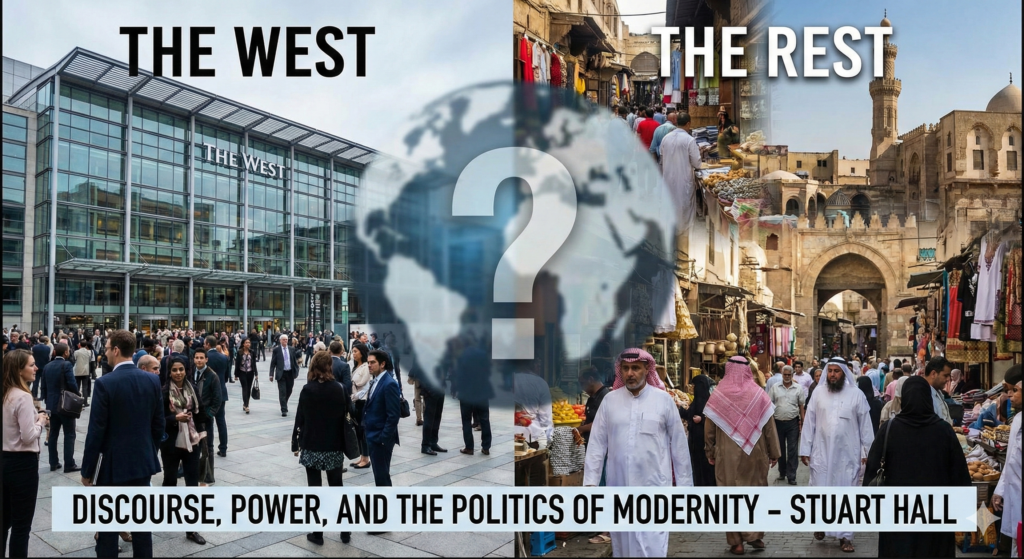
Hall explains that the idea of “The West” functions like an ideology in four main ways:
- Categorization: It divides the world’s societies into categories such as “Western” and “non-Western.” This simple division makes it easy to talk about groups of countries as if they were naturally grouped.
- Imagery: It creates a single, composite image or system of symbols for the West. For example, we might imagine “Western” societies as urban, advanced, and modern all at once. This set of images simplifies many complex realities into a stereotype or symbol.
- Comparison: It serves as a standard or model against which all other societies are measured. Other societies are seen in terms of how “close” or “far” they are from Western society. This establishes the West as the benchmark of development.
- Evaluation: It ranks societies according to Western standards. Typically, being “Western” is implicitly equated with being good or advanced, while being “non-Western” is associated with being underdeveloped or backward.
“The West” becomes a way of knowing and describing the world that carries hidden judgments. It produces a particular kind of knowledge—an ideology—about social and historical reality. The identity of the West is built up by emphasizing how it differs from “the Rest.” In other words, the West’s self-image is formed partly through the idea of who is not Western.
The Historical Formation: Europe and “The Other”
The concept of “The West” arose as Europe expanded beyond its borders. Hall notes that there were roughly five phases of European expansion—from early voyages of discovery to colonization and even modern forms of economic domination. Before this era of expansion, Europe saw itself mainly as part of Christendom (the community of Christian nations) rather than as a unified secular entity. Europe was relatively isolated by the Mediterranean Sea to the south and by the presence of the Islamic world to the east. In fact, the rise of Islam had acted as a “curtain” that blocked Europe’s access to Asia, keeping Europe contained for centuries.
The Age of Exploration (beginning in the 15th century) ended this confinement. When Europeans sailed around Africa to India or crossed the Atlantic to the Americas, they encountered many new peoples and lands. These encounters forced Europe to develop a new sense of identity. Hall points out that national cultures often define themselves by contrasting with others. When Europeans met indigenous peoples in the Americas, Africa, and Asia, they began to see themselves not only through their own history (like the Reformation or the Industrial Revolution) but also by comparing themselves to these new “Others.”
In this process, the identity of “The West” and “the Rest” were formed together. They became “two sides of a single coin” – both parts of the same global story. In other words, the idea of the West could not exist without the idea of non-Western “others.” European nations looked outward at the non-European world and developed a sense of themselves by highlighting differences. This meant that the story of how modern Western societies developed is intertwined with Europe’s contacts, conflicts, and relationships with the rest of the world.
Discourse, Power, and the “Regime of Truth”
To understand how the West described non-European societies, Hall uses the concept of discourse (drawing on the ideas of Michel Foucault). A discourse is more than just speech or writing; it is a whole system of ideas, images, and language that shapes how a topic is understood. Discourse determines which questions are asked, which answers are acceptable, and which facts are seen as true. Crucially, discourse is tied to power. The people or institutions with power can control the discourse and therefore control what is accepted as knowledge. In Hall’s words, “discourse is never innocent” – it always reflects power relations.
Hall highlights three key aspects of discourse in this context:
- Knowledge and Power: The groups that have social or political power also have the power to define the discourse. For example, European scholars, politicians, and missionaries who described indigenous peoples had the power to make those descriptions “official” or accepted as truth. Because of this, what was said about non-Western people often reflected European interests and justifications rather than objective fact.
- The Regime of Truth: A discourse produces a regime of truth, which means a set of accepted “truths” about society. Once a description becomes part of the official discourse, it can justify actions. For instance, if Europeans described indigenous people as “savages,” that idea became a “truth” that justified treating them as objects to be subdued or civilized. Those who controlled the discourse essentially decided what was to be considered true about the Rest of the world, organizing and regulating social relations on that basis.
- The Archive: When Europeans went to the New World or Asia, they did not arrive with a blank slate. They brought with them an archive of ideas from books, religious texts, myths, and earlier travel stories. This archive shaped what they were willing or able to see. For example, if classical stories mentioned monstrous tribes or gold-rich utopias, explorers were influenced by those images when they encountered real people. In many cases, Europeans actually saw what their archive told them to expect. The knowledge drawn from this archive affected how they interpreted new cultures, often misrecognizing them because they were looking through a pre-existing lens.
Representing “The Other”: Strategies of the Discourse
Hall explains that the Western discourse about non-Europeans used specific strategies to simplify and control how “the Other” was represented. One main strategy was stereotyping, which means reducing a whole people or culture to a few fixed traits. Stereotyping treats complex societies as if they were all the same in a certain way. Often, these stereotypes came in the form of “splitting” people into two extreme categories: something good or innocent on one side, and something bad or depraved on the other. This created a clear contrast between an ideal image and a degraded image of the “other.”
Idealization and Degradation
- Idealization: In some cases, Europeans idealized indigenous societies. They painted a picture of a “Golden World” or earthly paradise. In these fantasies, native peoples were simple, innocent, and noble in their purity. They lived close to nature in what was imagined as a perfect, harmonious state. This idea reflected European longings for a simpler life before modern problems—a kind of childhood of humanity untouched by greed or complexity. In this idealized view, the New World was sometimes depicted as an Eden where people were free of corruption.
- Degradation: In contrast, when indigenous peoples resisted European demands or didn’t fit European expectations, the discourse flipped to degradation. Suddenly the same people were called barbaric, savage, dirty, or cruel. The harshest image of this was cannibalism. Stories of native tribes eating humans became widespread. Cannibalism turned into the ultimate symbol of depravity and inhumanity. By emphasizing such negative images, Europeans justified treating native peoples harshly – enslaving them, making war on them, or seizing their land – because if they were “savages,” they were depicted as outside the bounds of civilized behavior.
By swinging between these two images, the Western discourse could paint non-European peoples either as noble children of nature or as beastly enemies. In both cases, indigenous people were not allowed to be seen as complex, autonomous societies. Instead, they were always shown in some way as “other” to the West.
Sexual Fantasy and Mis-recognition
Another strategy in the Western portrayal of “the Other” was sexual fantasy. The New World and its people were often sexualized in European imagination. For example, writers sometimes described America or its lands as a beautiful woman lying naked in a garden of abundant treasures, waiting for a strong European male to claim her. This image of the land itself as a woman symbolized possession and conquest, mixing exoticism with a subtle message that the West was taking what it wanted from the earth and its people.
Closely related was mis-recognition: Europeans routinely judged other societies by their own standards. They did not try to understand indigenous cultures on their own terms. For instance, many native societies traded gifts or shared food according to mutual customs, without using money or markets as in Europe. Europeans saw this and mistakenly declared that these people had “no economy” or were childlike because they did not practice buying and selling goods. In reality, those were just different economic systems. By failing to recognize native systems of exchange or law, Europeans often interpreted every difference as a sign of backwardness or innocence. This mis-recognition supported the idea that non-European societies were living in an earlier, simpler stage of history, reinforcing the West’s sense of superiority.
The “Noble” vs. “Ignoble” Savage and Enlightenment Thought
From these dual images of idealization and degradation emerged two famous stereotypes: the “Noble Savage” and the “Ignoble Savage.” These terms were especially influential in Enlightenment thinking about human society.
- Noble Savage: This figure was popularized by thinkers like Jean-Jacques Rousseau. The Noble Savage was imagined as a human being in a pure, uncorrupted state of nature. He (and it was usually assumed to be a man) lived simply, honestly, and happily without the lies and complications of European civilization. The Noble Savage served as a mirror to Europe: by comparing Europe to this idealized figure, Europeans critiqued their own society. They suggested that in becoming “civilized” they had lost something valuable—like innocence or moral simplicity—that these savages still had. The Noble Savage represented a kind of hidden potential within humanity that civilization had buried.
- Ignoble Savage: In contrast, the Ignoble Savage was described by writers like Thomas Hobbes. This figure embodied the idea that life in a “state of nature” without laws or civilization was “nasty, brutish, and short,” to use Hobbes’s famous words. The Ignoble Savage was depicted as aggressive, ignorant, and living in constant conflict. According to this view, without the order of society, humans would fall into chaos and cruelty. The Ignoble Savage justified the need for strong governments and European “civilizing” missions, suggesting that non-Western peoples needed guidance and control to achieve peaceful living.
These opposing images were key parts of the Enlightenment project to create a “science of society.” Enlightenment thinkers like Adam Smith and John Locke often used the idea of American indigenous peoples as the starting point or “zero point” of history. For example, Locke wrote “In the beginning all the World was America,” implying that Western civilization evolved out of a primitive condition like that of the American Indians. In their minds, history was a single line of progress, with all societies moving from “rude” to “refined.” On this one-dimensional scale, the West stood at the pinnacle. This linear view of social evolution placed every culture somewhere between the “primitive” stages (embodied by the Ignoble Savage idea) and the “civilized” stage of the modern West.
By using these Savage figures as reference points, Enlightenment thinkers built an image of world history as a ladder. Every nation had its position on this ladder according to how “civilized” it was, with Western Europe at the top. This framework ignored the unique paths of non-Western societies, treating all difference as simply being at an earlier rung on the same ladder.
From Discourse to Modern Sociology
Hall argues that the “West and the Rest” discourse carried over into the foundations of modern sociology. Early sociologists inherited many of the same assumptions about culture, progress, and the European model as the standard. In particular, even thinkers who were critical of Western society often took it for granted that Western history was the engine of global change.
Marx and Weber
- Karl Marx: Marx was focused on class struggle and capitalism, but he still used the discourse of West vs. Rest. For Marx, societies outside Europe were often seen as stagnant or lacking the dynamics of class conflict that drive change. He called the long-standing agrarian societies of Asia an “Asiatic mode of production,” implying they were static. Marx even argued that British colonialism in India, however brutal, had a kind of “historical necessity” because it broke up old structures and set the stage for modernization. In other words, he believed European intervention would eventually push other societies to develop in ways similar to Europe.
- Max Weber: Weber also contrasted Western and non-Western worlds. He pointed to the distinctive rational legal systems, bureaucracies, and capitalist economies in the West. In contrast, he described Eastern or Islamic societies as rooted in religious authority or family ties (for example, calling them “patriarchal” or “prebendary” systems). Weber argued that cultural or religious differences (like the absence of Protestantism) meant the East lacked some conditions for modern capitalism to emerge. Essentially, he used the same logic of difference: Western societies had unique traits (the Protestant Ethic, rational law) that allowed capitalism and modern society, which he rarely found in other places.
Both Marx and Weber, despite their many insights, accepted in various ways the idea that non-Western societies were on a different or earlier stage compared to Europe.
Internalist vs. Externalist Explanations
Hall criticizes these kinds of explanations as “internalist.” An internalist explanation looks only at the internal factors of Europe itself (like technology, religion, ideas, or the genius of Western people) to explain why modern society developed there. It treats Europe as if it rose alone, without considering how it interacted with the rest of the world.
Hall argues for an externalist or world-historical perspective instead. This view acknowledges that what made “the West” unique was not only internal developments but also its global relationships. The rise of Europe depended on resources, labor, and exchanges from around the world. For example, the wealth from colonialism and the slave trade was crucial to European economic growth. The way Europe defined itself (and others) was shaped by encounters and competition globally. In this view, we cannot fully understand Europe’s development without taking into account how Europeans exploited and contrasted themselves with other societies. Hall insists that the “Western model” of modernity was partly constructed through the domination of “the Rest.”
Thus, Hall calls for a more complete sociology of modernity—one that sees the West and the Rest as interconnected rather than separate. He suggests that the uniqueness of the West is not entirely self-made; it was built through a long history of global exchange, power, and representation.
Conclusion
The story of modernity, Hall reminds us, is a global story. It is a mistake to think of modern society as emerging only within Europe, independent of other regions. The concept of “The West” was created as a standard of power and knowledge that organized the world into a hierarchy of civilization. This discourse of “The West and the Rest” formed a powerful regime of truth, telling societies what it meant to be advanced or backward. Even today, these ideas influence how we perceive development and difference between nations.
In conclusion, the West’s own sense of identity was created by drawing lines between itself and everyone else. The history of “the Rest” – the lands and peoples outside Europe – was essential in making the idea of “the West” what it became. For Hall, understanding modern societies means remembering that Europe’s story was never isolated. It was deeply bound up with a world of others, all of whom were represented in certain ways by Western discourse. The West and the Rest, he shows, are part of the same history: each defines and shapes the other in the ongoing formation of modernity.