Introduction: From Terminology to Behavior
While kinship terminology tells you what to call your relatives, kinship usages tell you how to behave toward them. These usages are standardized behavioral norms, institutionalized patterns of interaction that govern how people of different kinship categories should relate to one another. They are not merely customs or suggestions but powerful social expectations enforced by moral sanctions, social pressure, and internalized values.
Kinship usages solve a fundamental problem that all societies face: how to manage the emotional intensities, potential conflicts, and structural tensions inherent in family life. Close kinship creates both profound intimacy and potential for conflict. Sexual attraction exists alongside incest taboos. Authority relations coexist with emotional bonds. Competition over resources occurs among people who are supposed to love each other. Kinship usages provide culturally standardized ways of managing these tensions.
A.R. Radcliffe-Brown, one of the pioneering theorists of kinship behavior, argued that these usages are so deeply internalized that they regulate conduct without requiring external force. The patterns become part of personality structure, making violations psychologically difficult even when no one is watching. Understanding kinship usages reveals how culture operates at the most intimate level of human life, shaping our most personal relationships according to social expectations.
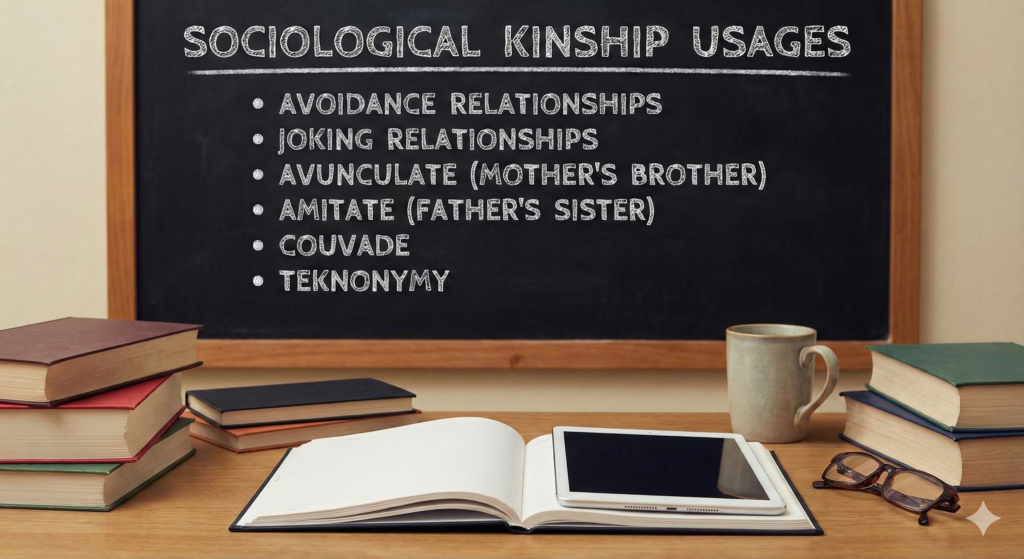
This article examines six major types of kinship usages: avoidance relationships, joking relationships, the avunculate (mother’s brother relationship), amitate (father’s sister relationship), couvade, and teknonymy. Each usage addresses specific structural tensions and serves particular social functions.
1. Avoidance: Formality and Distance in Relationships
Some kinship relationships are characterized by extreme formality and restricted contact, a pattern anthropologists call avoidance. In avoidance relationships, individuals must refrain from certain forms of interaction: they may not speak directly to each other, be in the same room alone together, look directly at each other, touch, or discuss certain topics (especially anything sexual).
These restrictions are not signs of hostility or dislike. Rather, they are formalized expressions of respect and mechanisms for preventing potential conflict. Avoidance maintains social distance in relationships that are structurally important but potentially problematic.
In-Law Avoidance
The most widespread form of avoidance occurs between in-laws, particularly between a man and his mother-in-law or between a woman and her father-in-law.
In many societies, a man must strictly avoid his wife’s mother. Among many Native American groups, a man could not speak directly to his mother-in-law, look at her face, or be alone with her. If he needed to communicate with her, he spoke through an intermediary (often his wife) or used indirect speech.
In North India, daughter-in-law avoidance was institutionalized through the practice of ghunghat (veiling) (now rarely practiced). When a bride enters her husband’s household, she must veil herself before her father-in-law and other senior male affines. She cannot speak directly to them, look at them, or call them by name. Over time, as she bears children and gains status in the household, these restrictions gradually relax.
Brothers-Sisters Avoidance
Another common form involves avoidance between brothers and sisters after they reach puberty. This pattern appears in many societies, though it varies in intensity.
The Trobriand Islands: Bronislaw Malinowski documented strict brother-sister avoidance among the Trobriand Islanders of Melanesia. After childhood, brothers and sisters could not eat together, discuss sexual matters in each other’s presence, or show physical affection. If they met on a path, they might turn away or pass without acknowledgment. This avoidance extended to the brother’s avoidance of his sister’s sexuality—he should never know about her romantic relationships.
The Vedda of Sri Lanka: The Vedda practiced such strict brother-sister avoidance that siblings could not be present in the same house together. If a brother arrived at the family dwelling, the sister would leave before he entered.
Theoretical Explanations
Why do societies institutionalize these avoidance patterns? Several theories have been proposed:
- Prevention of sexual tension: Radcliffe-Brown argued that avoidance prevents potentially incestuous sexual attraction in relationships where such attraction would be socially disruptive. The mother-in-law is sexually taboo (she belongs to an older generation and is married to the wife-giver), but the man lives in close proximity to her. Avoidance eliminates opportunities for sexual tension to develop. Similarly, brother-sister avoidance after puberty prevents the potential sexual attraction between siblings who have grown up in intimate proximity. The stringent avoidance ensures that the incest taboo is not violated even in thought or imagination.
- Respect and hierarchy: Avoidance can express respect for superior status. In patrilocal systems, the daughter-in-law’s avoidance of her father-in-law acknowledges his senior position in the household hierarchy. The formality maintains proper authority relations.
- Structural ambiguity: Some avoidance relationships involve positions that are structurally ambiguous or potentially conflictual. The mother-in-law gave the wife but might feel competitive with the son-in-law who “took” her daughter. Avoidance prevents potential resentment from erupting into open conflict.
- Role separation: Brother-sister avoidance may help maintain the separation between sibling bonds (asexual, enduring) and marital bonds (sexual, achieved). By making siblings strangers to each other’s sexual lives, the avoidance preserves the purity of the sibling relationship.
2. Joking Relationships: Licensed Familiarity
The structural opposite of avoidance is the joking relationship, a pattern that mandates or permits extreme familiarity, teasing, mock aggression, and even obscenity between certain categories of kin. In these relationships, behavior that would normally be insulting or inappropriate is not only permitted but expected.
Joking relationships involve what anthropologists call “permitted disrespect” – you can tease, insult, play tricks on, or even steal small items from your joking partner, and they cannot take offense. Indeed, taking offense would violate the relationship’s norms. The joking must be reciprocal, both parties have equal rights to tease.
- Cross-cousins: In many societies with Iroquois kinship terminology, cross-cousins (children of opposite-sex siblings) have joking relationships. They can speak freely about sexual matters, tease each other about romantic interests, and engage in playful banter that would be inappropriate with parallel cousins (who are classified as siblings).
- Among the Crow, a man could joke freely with his father’s sister’s daughter (his cross-cousin and potential wife), using sexual innuendo and teasing. This contrasts sharply with the respectful distance required with his mother’s brother’s daughter or his parallel cousins.
- Grandparent-grandchild: Many societies institutionalize joking relationships between alternate generations. Grandparents and grandchildren can tease each other freely, use nicknames, and engage in playful behavior. This contrasts with the more formal relationship between parents and children.
- Among some Native American groups, a grandfather and grandson might mock-fight, tell off-color jokes, and treat each other as equals despite the age difference. This familiarity creates special bonds of affection while skipping the authority tensions that characterize the parent-child relationship.
- Siblings-in-law: In societies practicing sororate (where a man marries his deceased wife’s sister) or levirate (where a woman marries her deceased husband’s brother), joking relationships often exist between potential spouses. A man might joke freely with his wife’s younger sister (whom he could marry if his wife dies), and this joking signals the potential intimacy of their future relationship.
Theoretical Explanations
- Release of structural tension: Radcliffe-Brown argued that joking relationships exist in positions of potential hostility or competition. The joking provides a safe channel for expressing aggression under the guise of humor. Because the teasing is institutionalized and reciprocal, it prevents genuine conflicts from emerging. Cross-cousins might potentially compete over resources or marriage partners, but the joking relationship transforms potential rivalry into playful competition. Siblings-in-law are connected through marriage alliance but belong to different kin groups with potentially conflicting interests. The joking creates familiarity and affection that overcomes potential distance or hostility.
- Preparation for intimacy: Joking relationships often exist between potential marriage partners (cross-cousins, wife’s younger sister). The permitted sexual teasing and familiarity prepare the ground for potential future marriage. If a man’s wife dies and he marries her younger sister (sororate), the joking relationship has already established the intimacy and comfort needed for the new marriage.
- Social equality: The reciprocal nature of joking relationships creates a sense of equality even when status differences exist. Grandparents and grandchildren are separated by age and generation, but the joking relationship treats them as equals, creating special bonds of affection unencumbered by authority.
- Tension management: In any close relationship, frustrations and irritations accumulate. Joking relationships provide institutionalized ways to express these feelings without threatening the relationship. The insult is simultaneously real (expressing genuine feeling) and not real (it’s “just joking”). This ambiguity allows emotional expression while maintaining social bonds.
3. The Avunculate: The Mother’s Brother Relationship
The avunculate refers to the institutionalized, special relationship between a man and his mother’s brother (maternal uncle). This relationship takes on particular importance in matrilineal societies but exists in various forms across many cultures. The avunculate became famous in anthropology through the debate between Bronislaw Malinowski and A.R. Radcliffe-Brown about its nature and significance, a debate that helped establish the importance of understanding kinship in structural-functional terms rather than merely psychological or biological terms.
The Trobriand Case: Malinowski’s Discovery
Bronislaw Malinowski’s ethnography of the Trobriand Islanders (a matrilineal society in Melanesia) revealed a striking pattern: the mother’s brother, not the biological father, held primary authority over a child.
- Authority and discipline: The mother’s brother is the stern authority figure who disciplines the child, makes major decisions about the child’s life, and controls the child’s future.
- Inheritance: A boy inherits property, magic spells, and social position from his mother’s brother, not from his biological father. The mother’s brother is the legal guardian and jural authority.
- Residence: As boys mature, they often leave their parents’ household to live with and work for their mother’s brother, learning from him and eventually inheriting his position.
- Emotional distance: The relationship with the mother’s brother tends to be formal and authoritative, characterized by obedience and respect rather than warmth.
- Contrast with father: The biological father is an affectionate, indulgent figure who plays with children and shows them warmth but has no legal authority over them. Father and children enjoy a relationship of friendship rather than authority.
The Matrilineal Puzzle
This pattern reflects what anthropologists call the “matrilineal puzzle”—a structural tension inherent in matrilineal systems. In these societies, a man belongs to his mother’s matrilineage, and his heirs are his sister’s children, not his own children. Yet he lives with his wife and his biological children, developing emotional bonds with them.
This creates a split:
- Jural authority and inheritance: Flow through the matriline (mother’s brother to sister’s son)
- Affection and daily contact: Flow through the conjugal family (father to biological children)
A man faces divided loyalties. He should invest resources in his sister’s children (his matrilineal heirs), but he naturally wants to help his own biological children. His sister’s children inherit from him, but his own children must look to their maternal uncle (their mother’s brother) for inheritance.
The avunculate solves this tension by institutionalizing the separation of authority from affection. The mother’s brother provides discipline and jural authority; the biological father provides emotional warmth. Neither role is complete, but together they fulfill the functions of fatherhood.
The avunculate exists in varying forms beyond classic matrilineal societies. Even in patrilineal societies, the mother’s brother often has a special role. Among the Nuer (strongly patrilineal), a boy has warm, affectionate relationships with his maternal uncles, who provide gifts, support, and refuge if the boy conflicts with his paternal kin. The mother’s brother represents the maternal lineage—the wife-givers—and maintains that alliance. In ancient Rome (patrilineal), the avunculus (maternal uncle) often played an important role in a boy’s education and career advancement, complementing the father’s authority with mentorship and support. Even in contemporary bilateral societies, some children have special relationships with maternal uncles, though these are more variable and less institutionalized than in traditional societies.
Theoretical Significance
Radcliffe-Brown used the avunculate to argue that kinship relationships must be understood structurally, not psychologically. The special role of the mother’s brother is not about individual psychology or biological instinct—it reflects the structural position of this relative in the kinship system. In matrilineal societies, he is the jural authority; in patrilineal societies, he represents the maternal kin group. The relationship’s character follows from its structural position.
4. The Amitate: The Father’s Sister Relationship
Amitate (from Latin amita, father’s sister) refers to the special authority or significance of the father’s sister in many kinship systems. This usage has received less anthropological attention than the avunculate but is equally important in many societies.
In various societies, the father’s sister holds special authority, prestige, or ritual significance, sometimes greater than that of the mother. Among the Toda, the father’s sister (atni) is treated with supreme respect and holds significant authority. She plays crucial roles in naming ceremonies, marriage arrangements, and life-crisis rituals. She is often called a “female father,” indicating her identification with the patrilineal group. In Tongan (Polynesian) society (patrilineal), the father’s sister (mehekitanga) holds the highest status among female relatives. She has authority over her brother’s children and plays central roles in family ceremonies. The respect shown to her exceeds even that shown to the mother. In many North Indian communities, the father’s sister (bua or phua) holds special affection and authority. She has the right to tease and demand gifts from her brother’s children, and she plays important roles in arranging marriages and family rituals.
Theoretical Explanations
- Maintaining female lineage members’ status: In patrilineal societies, women marry out and might lose status in their natal lineages. The amitate ensures that female members of the patrilineage retain honored positions and authority. The father’s sister remains a member of her natal patrilineage and exercises authority as its representative.
- Lineage continuity: The father’s sister represents the continuing presence of the paternal lineage. Even though she married out, she maintains ties to her natal lineage and serves as an important link between her natal family and her married family.
- Gender complementarity: The amitate creates a female counterpart to male lineage authority. In patrilineal systems dominated by male authority figures, the father’s sister provides an important female authority figure who is not subordinated by marriage into another family (as the mother is).
- Balance of maternal and paternal influence: Just as the mother’s brother represents the maternal kin in patrilineal societies, the father’s sister represents the paternal kin in matrilineal societies or provides a paternal-side female authority in patrilineal societies. This creates balance and prevents excessive concentration of influence in one line.
5. Couvade: Simulated Paternity
Couvade (from French couver, to hatch) is a ritual complex in which fathers simulate the symptoms and behaviors of pregnancy and childbirth when their wives give birth. This practice, found in diverse societies, represents one of the most puzzling and fascinating kinship usages.
Couvade Practices
The specific practices vary but typically include some combination of:
- Behavioral restrictions: The father retires to bed or seclusion when the mother goes into labor. He may remain secluded for days or weeks after birth.
- Dietary taboos: The father observes strict food restrictions, avoiding certain meats, spices, or other foods believed to harm the infant.
- Simulated symptoms: In some groups, the father writhes in simulated pain, groans, and acts as if he is experiencing labor pains.
- Post-partum rest: After the birth, the father rests in bed and receives care, as if he had given birth, while the mother may return to work relatively quickly.
- Ritual isolation: Both father and mother may observe isolation periods, during which they avoid certain people, places, or activities to protect the vulnerable infant.
Ethnographic Examples
Khasi (of North-East India) fathers observe elaborate couvade restrictions, avoiding certain foods and activities for extended periods after a child’s birth. Toda (of South India) fathers perform ritual acts that symbolically establish their connection to the child, though not full couvade. Many Amazonian (South American Indigenous people) groups practice elaborate couvade, with fathers observing lengthy restrictions and acting as if they had given birth.
Theoretical Interpretations
- Establishing paternity: The most common interpretation, proposed by Tylor and Malinowski, argues that couvade serves to establish social paternity. In societies where biological paternity might be uncertain or where social fatherhood is more important than biological fatherhood, the couvade publicly declares the father’s connection to the child.
- By “going through” childbirth himself, the father makes a public claim: “This is my child.” The ritual establishes his social rights over the child and his obligations to the child and mother.
- Protecting the infant: Many societies believe that the father’s behavior during and after birth directly affects the infant’s health and fate. The dietary restrictions and behavioral taboos protect the vulnerable newborn from supernatural harm. The father’s discipline demonstrates his commitment to the child’s welfare.
- Binding the nuclear family: The couvade creates a period when both parents focus intensely on the infant, strengthening the conjugal bond and establishing the nuclear family unit. It emphasizes that the child belongs to both parents, not just to the mother or her lineage.
- Male participation in reproduction: In societies where pregnancy and birth are exclusively female domains, couvade provides a way for men to participate symbolically in reproduction, acknowledging their role and creating connection to the mysterious process of birth.
6. Teknonymy: Naming After Children
Teknonymy is the practice of renaming parents after their children, referring to them as “mother of X” or “father of Y” rather than by their personal names. This practice appears in diverse societies and serves multiple functions.
The practice of using Abu (father of) and Umm (mother of) is widespread in Arab Societies. A man might be called Abu Ahmad (father of Ahmad) rather than by his given name. This honorific increases in usage as people age and have children. In Indonesian and Malay societies similar practices exist, with parents commonly referred to by their children’s names rather than their own. In many Indian communities, women are renamed after bearing children, becoming “Raj’s mother” rather than being called by their given names. This is especially common in joint family contexts where multiple women of the same generation live together. Clifford Geertz documented elaborate teknonymy practices in Bali, where personal names become increasingly unused as people have children and grandchildren, with teknonymous names indicating one’s position in the generational cycle.
Functions and Significance
- Marking achieved status: Teknonymy emphasizes that full adult status comes through reproduction. Being a parent is more socially important than being an individual. The practice marks the transition from young adult to full social person.
- Strengthening family bonds: By making the child the explicit link between the parents (“mother of Ahmed” is married to “father of Ahmed”), teknonymy emphasizes the child as the foundation of the family unit. The parents’ identities become defined through their relationship to the child.
- Avoidance function: In some contexts, teknonymy serves an avoidance function. A wife avoids using her husband’s personal name as a sign of respect. Referring to him as “father of [child]” solves this problem while maintaining the avoidance norm.
- Generational marking: As people move through life stages—having children, then grandchildren—their teknonymous names change, marking their position in the generational cycle. In Bali, a person might move from personal name to “father of X” to “grandfather of Y,” with each change marking generational progression.
- Social integration: In communities where many people share the same given names, teknonymy provides unique identifiers. “Father of Ahmed” is more specific than “Mohammed” when there are many Mohammeds in the village.
- Cosmological significance: In some societies, having children and being named for them connects one to the cycle of generations, linking past and future. The teknonymous name marks one’s place in the eternal cycle of birth, reproduction, and death.
Conclusion
Kinship usages—avoidance, joking, the avunculate, amitate, couvade, and teknonymy—demonstrate how culture penetrates into the most intimate aspects of human life, shaping how we relate to our closest kin. These are not optional customs but deeply internalized norms that become part of personality structure. Understanding kinship usages provides several important insights:
- Culture shapes emotion: These usages show that even emotions and intimate behaviors are culturally patterned. How we express affection, respect, authority, or distance toward relatives follows cultural scripts, not just individual psychology.
- Structural analysis: The usages demonstrate how social behavior reflects structural positions. The same relative (mother’s brother) can be warm and indulgent in one society but stern and authoritarian in another, depending on the kinship structure.
- Conflict management: Many usages exist specifically to manage structural tensions—the potential for sexual attraction, competition over resources, conflicts between authority and affection. Culture provides standardized solutions to universal human dilemmas.
- Comparative perspective: The diversity of kinship usages—from mother-in-law avoidance to couvade—challenges ethnocentric assumptions about “natural” family behavior. What seems natural in one culture may be prohibited in another.
- Social integration: These usages help maintain social order by regulating behavior, clarifying expectations, and preventing conflicts. They create predictability in social life and transform biological relationships into orderly social relationships.
Understanding kinship usages reveals the remarkable sophistication of traditional societies in managing the challenges of family life. Without formal institutions, therapy, or legal systems, these societies developed elegant solutions to the structural tensions inherent in kinship. These solutions—encoded in behavioral norms and internalized through socialization—create stable, predictable patterns of interaction that allow families and communities to function smoothly across generations.
These patterns also raise questions: As kinship systems change and modernize, what happens to these usages? Can modern societies create new usages to manage new kinship forms (step-families, blended families, same-sex parent families)? How do traditional usages adapt to contemporary contexts? These questions connect classical kinship studies to contemporary concerns about family change and social transformation.