Introduction: The Crisis of the Modern Mind and the Genesis of Sociological Reflexivity
The intellectual landscape of early twentieth-century Europe was defined by a profound and unsettling disintegration. The unified worldviews that had anchored Western thought—whether religious, metaphysical, or Enlightenment rationalism—had fractured under the pressures of modernity, industrialization, and the cataclysm of the First World War. It was within this milieu of fragmentation that Karl Mannheim, a Hungarian-born sociologist operating within the vibrant yet volatile intellectual culture of the Weimar Republic, formulated a theoretical apparatus designed not merely to describe this crisis, but to master it. His magnum opus, Ideology and Utopia (1929), does not stand merely as a historical artifact of interwar German sociology; it represents the foundational text for the Sociology of Knowledge (Wissenssoziologie), a discipline predicated on the radical assertion that human thought is not an autonomous, abstract process occurring in a vacuum of pure logic, but is fundamentally “existentially determined” (seinsverbunden).
This text serves as a critical examination of the concepts of Ideology and Utopia within Mannheim’s framework.
Mannheim’s intervention was a direct response to the “crisis of reality” that characterized his epoch. He observed that in modern society, truth had ceased to be a singular, objective standard and had instead dissolved into a plurality of conflicting “Weltanschauungen” (worldviews), each claiming absolute validity while mutually invalidating the others. This condition, which Mannheim diagnosed as the “plurality of worldviews,” resulted in a communicative breakdown where competing social groups—conservatives, liberals, socialists, and fascists—did not merely disagree on the facts of political life; they inhabited fundamentally different mental universes, employing different categories of thought, different conceptions of time, and different criteria for validity. They were, in effect, talking past one another, locked in a struggle not just for political power, but for the power to define reality itself.
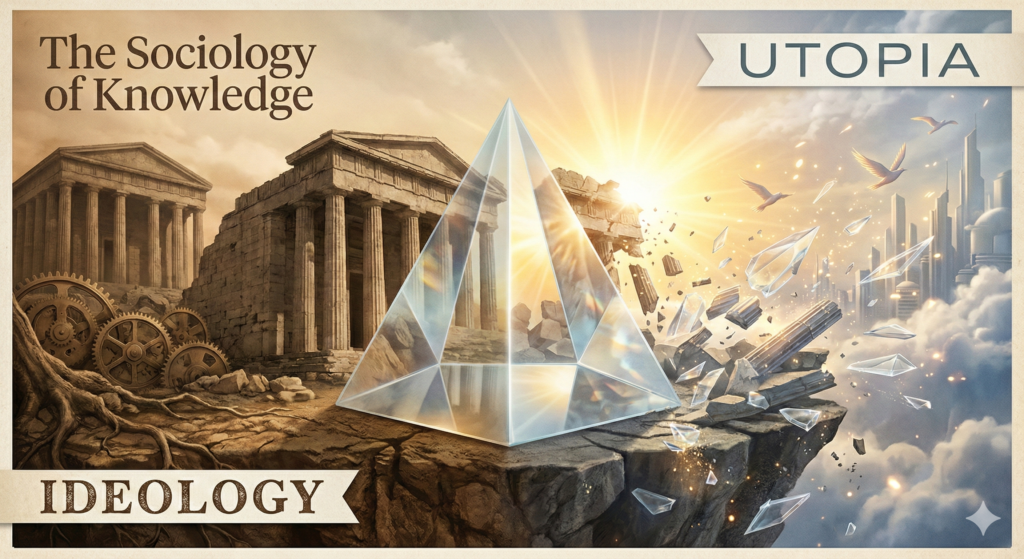
The central thesis developed here posits that Mannheim’s sociology of knowledge was never intended as a retreat into relativism, as his critics often charged, but rather as a therapeutic “organon for politics as a science”. By unmasking the unconscious motivations behind political thought, Mannheim aimed to clear the ground for a “dynamic synthesis”—a precarious but necessary integration of conflicting perspectives facilitated by a “free-floating intelligentsia.”
The Existential Determination of Knowledge (Seinsgebundenheit)
The Sociological Turn in Epistemology
Traditional epistemology, stemming from the Kantian tradition and extending through the neo-Kantians of the late 19th century, operated largely on the premise of a “consciousness as such” (Bewusstsein überhaupt)—a universal, ahistorical, and transcendental subject capable of perceiving objective truth independent of external conditions. Mannheim radically broke with this tradition by asserting that the very structure of human consciousness is molded by the social currents in which the subject is immersed. This is the principle of Seinsgebundenheit des Wissens, or the existential connectedness of knowledge.
Mannheim argues that thought does not generate the world; rather, the social world generates the categories of thought. When an individual speaks, thinks, or judges, they do not do so as a solitary “I,” but as part of a “we.” The syntax, logic, and conceptual apparatus available to any thinker are pre-formed by the historical group—class, generation, status group, or sect—to which they belong. Thus, knowledge is not a passive reflection of reality, as the positivists might claim, but an active, selective engagement with it, driven by the “voluntaristic” impulses of the group.
This sociological turn shifts the analytical focus from the validity of a statement (is it true?) to its genesis (where does it come from?). However, unlike the “genetic fallacy” in formal logic, which dismisses an idea based on its origin, Mannheim contends that the origin of an idea constitutes its meaning and perspective. In the political and social sphere, there is no “view from nowhere.” Every perspective is partial, limited by the “standpoint” (Standort) of the observer. This necessitates a new epistemological framework that can account for the perspectival nature of truth without collapsing into nihilism.
The Crucial Distinction: Relativism vs. Relationism
A persistent and formidable critique of the sociology of knowledge is that by tying truth to social location, it renders all truth relative, thereby making objective knowledge impossible and reducing all intellectual disputes to contests of power. If all thought is ideologically bound, then the sociology of knowledge itself is merely another ideology, devoid of any privileged claim to truth. Mannheim was acutely aware of this danger and vigorously defended his work against the charge of relativism by introducing the concept of Relationism.
- Relativism implies that because all views are subjective and historically contingent, they are all equally arbitrary and valid; truth becomes a matter of taste, preference, or political convenience. Relativism is a product of a static conception of truth that demands eternal, unchanging absolutes. When these absolutes are shown to be historically variable, the relativist concludes that “truth” does not exist.
- Relationism, in contrast, asserts that while knowledge is dependent on a specific historical and social context, it is objectively valid within that context. Mannheim frequently employs analogies from physics to illustrate this point: just as the measurement of spatial dimensions depends on the position and velocity of the observer (as in relativity theory), social knowledge depends on the position of the social actor. The fact that a perspective is perspectival does not make it false; it makes it “relationally” true.
Relationism signifies that certain elements of meaning can only be formulated and understood in conjunction with the social situation. The “truth” of a political statement, for instance, cannot be detached from the social “vital space” (Lebensraum) from which it emerges. Thus, the sociology of knowledge does not destroy truth; it “particularizes” it, defining the scope and limits of its validity. By acknowledging the partiality of all perspectives, relationism opens the door to a higher level of objectivity—not the objectivity of a detached god, but the objectivity of a synthesis that integrates multiple partial viewpoints.
The “Social Equation” in Political Thinking
In the realm of the “properly political”—which Mannheim distinguishes from mere administration or established routine—the evaluative element of thought is inextricable from the descriptive element. Political thinking is never neutral; it is always driven by a “will to change” or a “will to maintain” the existing social order. Consequently, what Mannheim terms the “social equation”—the sum of social factors, class interests, and unconscious motivations influencing a perspective—must be factored into any rigorous analysis.
Mannheim maintains that in the political sphere, the “voluntaristic” element has an essential significance for knowledge. We do not first perceive facts and then make judgments; our judgments and interests direct our attention to certain facts while obscuring others. For example, a Marxist economist and a Neoclassical economist do not just interpret data differently; their theoretical frameworks illuminate entirely different sets of data while rendering others invisible.
Mannheim suggests that the pursuit of “objectivity” in the social sciences requires a constant, rigorous “unmasking” of this social equation. A social scientist cannot simply strip away their values to become objective; instead, they must critically engage with their own “social equation,” recognizing how their class position, generational location, and cultural milieu shape their theoretical framework. This reflexivity is the prerequisite for what Mannheim terms “scientific politics”—a mode of politics that is aware of its own limitations and the partiality of its truths.
The Ideology: Obscuring the Present
Mannheim’s reformulation of the concept of ideology is arguably his most significant contribution to sociological theory. He moves beyond the colloquial or purely Marxist understanding of ideology as “false consciousness” or deliberate deception to a more sophisticated, structural typology that accounts for the unconscious determination of thought.
Definition of Ideology
Fundamentally, Ideology refers to those complexes of ideas that direct activity toward the maintenance of the existing order. Ideologies are “situationally transcendent” in that they claim absolute validity and often appeal to values (like Christian charity or liberal freedom) that are not fully realized in practice. However, their primary social function is to obscure the “real condition of society” to stabilize the status quo.
Ideological thinking is characterized by a peculiar blindness: ruling groups, in their anxiety to preserve their power, become structurally unable to see certain facts that would undermine their position. This is not necessarily a calculated lie (though it can be); it is often an unconscious flight from a reality that has become threatening. The “collective unconscious” of the group filters reality, admitting only those data points that reinforce the stability of the current regime.
The Typology of Ideology: Particular to Total
Mannheim distinguishes between two distinct levels of ideological analysis: the “particular” and the “total.” This distinction is critical for understanding the evolution of modern political discourse.
a) The Particular Conception of Ideology
The Particular Conception operates on a psychological and individualistic level. It involves questioning only specific assertions of an opponent. The analyst regards these assertions as conscious lies, concealments, or deceptions driven by individual interests.
- Characteristics:
- The integrity of the opponent’s total mental structure is not challenged.
- There remains a shared criterion of validity; both parties agree on what “truth” is, but one is accused of hiding it.
- It effectively treats ideology as a “lie” or an “error”.
- Example: Accusing a politician of fabricating employment statistics to win an election is an application of the particular conception. It assumes the politician knows the truth but conceals it for personal gain.
b) The Total Conception of Ideology
The Total Conception represents a paradigm shift from psychology to sociology. It calls into question the opponent’s entire Weltanschauung (worldview), including their conceptual apparatus, categories of thought, and criteria of validity.
- Characteristics:
- It operates on a noological (structural) level, not psychological.
- It assumes that the opponent’s thought is a function of their objective social position (e.g., class, epoch).
- There is no shared ground of truth; the very meanings of words differ between the groups.
- The consciousness of the group is seen as structurally distorted, not merely ethically flawed.
- Example: The conflict between a feudal aristocrat and a modern capitalist is not merely a disagreement over facts; it is a clash of total thought systems. The aristocrat’s concept of “honor” and “obligation” is structurally incompatible with the capitalist’s concepts of “contract” and “profit.” The aristocrat cannot think in capitalist terms not because he is lying, but because his social reality does not provide the categories for it.
From Special to General Ideology: The Birth of SoK
Mannheim further nuances the total conception by distinguishing between the “Special” and the “General” formulations, a transition that marks the birth of the Sociology of Knowledge proper.
- Special Total Ideology: The analyst applies the total conception only to the adversary. This is the method of Marxism as a weapon: “Your thought is bourgeois ideology; mine is scientific truth”. It unmasks the opponent but exempts the self.
- General Total Ideology: The analyst possesses the courage to apply the method to all viewpoints, including their own. This unmasking of one’s own position transforms ideology critique from a partisan weapon into a scientific method of research.
When the “General” form is adopted, the accusation of “falsity” drops away, replaced by the neutral investigation of the relationship between social position and perspective. This is the methodological foundation of the Sociology of Knowledge.
Case Study: The Church’s Taboo on Usury
Mannheim provides a compelling historical example of how a norm transforms into an ideology. In the Middle Ages, the Church’s taboo on interest-taking (usury) was a functioning norm congruent with the feudal economic reality, where economic relations were personal and non-accumulative. However, as capitalism emerged, interest-taking became an economic necessity for the functioning of the new market society.
- The Shift: The taboo could no longer be obeyed; it could only be circumvented. Yet, the Church maintained the prohibition.
- Ideological Function: At this stage, the taboo ceased to be a valid ethical norm and became an ideology—a weapon used by the Church to fight the rising power of the bourgeoisie.
- The Revelation of Ideological Nature: In the course of the complete emergence of capitalism, the ideological nature of this norm became “patent” (obvious). The norm’s ideological nature was revealed by the fact that it could only be circumvented and not obeyed.
- The Church’s Response: Eventually, the incongruence between the idea (taboo) and reality (capitalism) became so glaring that the Church was forced to discard the norm to survive. This illustrates Mannheim’s “evaluative” conception of ideology: an idea is ideological when it uses categories that prevent adjustment to the present historical stage.
The Utopia: Shattering the Present
If ideology is the mental shield of the status quo, Utopia is the intellectual battering ram of the oppressed. Mannheim defines utopia as a state of mind that is incongruous with the state of reality and, crucially, tends to shatter the order of things when translated into conduct.
Unlike the literary definition of utopia as an impossible “nowhere” (stemming from Thomas More), Mannheim’s sociological utopia is defined by its function: it is the orientation that transcends reality to transform it. The distinction between ideology and utopia is often only visible in hindsight; ideas that successfully transform society are retrospectively judged as “utopias,” while those that fail or merely obscure reality are judged as “ideologies”. A “utopia” that is realized becomes the reality of tomorrow; a “utopia” that fails remains a mere wish-fantasy. Conversely, an “ideology” is a truth that has withered into a lie because it no longer aligns with the changing historical reality.
The Utopian Mentality and the Conception of Time
Mannheim argues that the “utopian mentality” is not uniform; it evolves historically, and each form possesses a distinct experience of time. This temporal dimension is critical for understanding how different groups act in history. He identifies four major historical types of the utopian mentality.
i) The Orgiastic Chiliasm of the Anabaptists
The first and most radical form of the utopian mentality emerged with the Anabaptists (e.g., Thomas Müntzer) in the crumbling feudal order of the 16th century.
- Social Base: The lowest, most oppressed strata of society (peasantry, early proletariat).
- Time Perception: Absolute Presentness (hic et nunc). The Chiliast does not wait for a gradual evolution; they expect the millennium to break into the world “here and now.”
- Nature: It is ecstatic, orgiastic, and irrational. It rejects the “dead” time of the calendar for the “filled” time of the moment (Kairos). It represents a complete rupture with history. The Chiliast sees no value in the past or the distant future; the only reality is the immediate, explosive transformation of the world.
ii) The Liberal-Humanitarian Idea
With the rise of the bourgeoisie, the ecstatic energy of Chiliasm was tamed and rationalized into the Liberal-Humanitarian idea (Enlightenment thought).
- Social Base: The middle class, bourgeoisie, and intellectuals.
- Time Perception: Linear Evolution. The “utopia” is projected into a distant future as an “Idea” (e.g., eternal peace, the rule of reason). This Idea serves as a “measuring rod” to judge the present and guide gradual progress.
- Nature: It creates a formal relationship between the idea and reality, bridging the gap through “progress” rather than explosive rupture. It seeks to shape the future, not shatter the present instantaneously. Time is experienced as an infinite line of improvement.
iii) The Conservative Idea
Mannheim argues that conservatism originally had no utopia; it was unconsciously embedded in reality. It was only when attacked by Liberalism and Chiliasm that it was forced to develop a “counter-utopia.”
- Social Base: The landed aristocracy and ruling elites.
- Time Perception: Spatialization of Time / Focus on the Past. Conservative thought emphasizes the “incubation” of the past in the present. It sees time not as a linear line but as a natural, organic growth.
- Nature: It values the “what is” as the result of a long process of “becoming.” It rejects the abstract “ought” of the liberals in favor of the concrete “is” of existing institutions (Hegel, Savigny). It essentially claims that “reality is rational,” thereby engaging in an ideological defense that masquerades as a utopia of the concrete.
iv) Socialist-Communist Utopia
The fourth form synthesizes elements of the previous types, representing the worldview of the proletariat.
- Social Base: The industrial working class and socialist intellectuals.
- Time Perception: The Future in the Present. Unlike the distant liberal future or the ecstatic chiliastic present, the socialist utopia sees the future as strategically embedded in the dialectical contradictions of the present.
- Nature: It is a “dynamic synthesis” of Chiliastic energy and Liberal rationality. It locates the “kairos” (the opportune moment) within a calculated timeline of economic and social breakdown (e.g., the collapse of capitalism). It is the only form that attempts to align utopia strictly with the socio-economic structure.
Table 1: Mannheim’s Typology of Utopian Mentalities
| Utopian Form | Social Carrier | Conception of Time | Goal |
| Orgiastic Chiliasm | Oppressed Peasantry (Anabaptists) | Absolute Presentness (Kairos). No past, no future, only the explosive “Now.” | Rupture. The millennium happens now. |
| Liberal-Humanitarian | Bourgeoisie / Intellectuals | Linear Progress. Time is an infinite line. The “Idea” regulates progress. | Evolution. Gradual improvement guided by reason. |
| Conservative Idea | Aristocracy / Ruling Elite | Spatialization of Time. Focus on the Past and organic growth. | Preservation. Reality is “irrational” and unmakeable. |
| Socialist-Communist | Proletariat | Future in the Present. Time is dialectical. The future is strategically decided in the present. | Revolution. Structural transformation of the economy. |
This typology suggests that political conflict is often a conflict of temporalities. The liberal wants to delay the revolution (linear time); the chiliast wants it immediately (absolute present); the conservative wants to return to the incubation of the past. They cannot agree because they literally experience history differently.
Conservatism and the Morphological Method
While “ideology” and “utopia” are the twin pillars of Mannheim’s mature theory, his earlier habilitation thesis, “Conservative Thought” (Das konservative Denken), provides the essential methodological groundwork. Here, Mannheim applies a morphological method to understand the structure of conservative thought, distinguishing between “traditionalism” (a psychological impulse) and “conservatism” (a conscious political style).
Bureaucratic Conservatism vs. Conservative Historicism
Mannheim identifies competing strains within the conservative response to modernity.
- Bureaucratic Conservatism: This is the administrative rationality of the state official. It seeks to manage social problems through technical means, suppressing the “political” impulses of the masses. It is anti-revolutionary but also anti-traditional; it values order and efficiency above all.
- Conservative Historicism: This is the intellectual counter-movement to the Enlightenment (e.g., Hegel, Savigny, the Historical School of Law). It rejects the “abstract” reason of the liberals and bureaucrats in favor of the “concrete” history of the nation. It argues that laws and institutions cannot be “made” by reason but must “grow” organically over time.
The Style of Thought (Denkstil)
Mannheim uses the concept of Denkstil (style of thought) to analyze how these groups process reality. The conservative style is characterized by a preference for the concrete over the abstract, the qualitative over the quantitative, and the organic over the mechanical. This morphological analysis allows Mannheim to demonstrate that “conservatism” is not just a political platform but a distinct cognitive apparatus for perceiving the world.
The Unmasking Turn of Mind and the History of Debunking
Mannheim traces the history of the “unmasking turn of mind”—the methodical exposure of the social roots of thought—as a distinct feature of modernity. This historical genesis reveals how the tool of unmasking evolved from a weapon of the Enlightenment into the instrument of its own crisis.
- Pre-Sociological Phase (The Concept of Cant): In the early stages, debunking took the form of exposing “cant” or the “priestly lie” (Voltaire). Distortions were viewed as conscious deceptions by elites to maintain power. The assumption was that if the “lie” were removed, the “truth” would be self-evident to all rational men.
- Hegelian/Marxist Phase (False Consciousness): With Hegel and Marx, ideology became “false consciousness,” a necessary illusion generated by the objective economic structure (e.g., commodity fetishism). Here, unmasking became a weapon of class warfare. The proletariat could “unmask” the bourgeoisie, but the bourgeoisie could not validly unmask the proletariat because the proletariat represented the future universal class.
- Mannheim’s Phase (Universal Suspicion): In the 20th century, the “unmasking” becomes universal. When all groups unmask each other, the “privileged” status of any single group evaporates. Everyone is unmasked; everyone is shown to be speaking from a partial, interested standpoint.
This universal unmasking leads to a crisis of confidence in thought itself. If everyone is ideologically biased, is truth possible? Mannheim answers this with his theory of Dynamic Synthesis mediated by the Intelligentsia.
The Free-Floating Intelligentsia (Freischwebende Intelligenz) and Dynamic Synthesis
The Sociological Location of the Intelligentsia
Who can synthesize these warring perspectives? Mannheim places his hope in a unique social stratum: the “socially unattached” or “free-floating intelligentsia” (freischwebende Intelligenz), a term he borrowed and adapted from Alfred Weber.
Unlike the proletariat or the bourgeoisie, whose interests are rigidly bound to their economic position (labor vs. capital), the intelligentsia is recruited from various social strata. Their specific social bond is Education (Bildung). Through a shared humanist education, intellectuals from different classes are brought together and exposed to conflicting worldviews. This “interstitial” social location allows them a degree of detachment—not absolute freedom, but a relative freedom from the rigid class interests that blind others.
The Mission: Dynamic Synthesis
The function of the intelligentsia is not to produce a new ideology but to facilitate a Dynamic Synthesis.
- Additive Synthesis: Merely piling different viewpoints together (eclecticism), which results in a disjointed mess.
- Dynamic Synthesis: A higher-level integration that resolves the contradictions between conflicting perspectives (ideologies and utopias) by locating them within a broader historical context. It requires a continuous reformulation of the “total view” as history evolves.
The intellectual’s task is to act as a “watchman in the night,” diagnosing the total situation. By understanding the partial truth of the conservative (stability), the liberal (freedom), and the socialist (equality), the intellectual can construct a “total perspective” that serves the whole of society rather than a single class. This is the political mission of the sociology of knowledge.
The Great Debate: Mannheim vs. The Frankfurt School
Mannheim’s Ideology and Utopia was not received passively; it sparked one of the most intense intellectual rivalries of the 20th century, particularly with the critical theorists of the Frankfurt School, Max Horkheimer and Theodor Adorno.
Horkheimer’s Critique: The Neutralization of Marxism
In “A New Concept of Ideology” (1930), Max Horkheimer attacked Mannheim for “neutralizing” Marxism.
- The Argument: Horkheimer argued that by treating Marxism as just “one ideology among others” (the general total conception), Mannheim stripped it of its truth-value and revolutionary potential. Mannheim reduced the life-and-death struggle of class warfare to a polite academic discussion of “perspectives.”
- The Charge: For Horkheimer, Mannheim’s sociology of knowledge was a “bourgeois” defense mechanism that sought to harmonize contradictions that could not be harmonized in reality, only in thought. It replaced the critique of capitalism with a mere typology of worldviews.
Adorno’s Critique: The False Harmony
Theodor Adorno was even more scathing. He viewed Mannheim’s obsession with “synthesis” as a dangerous delusion.
- Negativity vs. Synthesis: Adorno argued that the goal of theory is to expose contradictions (negativity), not to smooth them over in a false synthesis. Society is contradictory; therefore, true theory must reflect that fracture, not paper over it.
- The Elite Fantasy: Adorno viewed the “free-floating intelligentsia” as an elitist fantasy that ignored the material reality of intellectual production. Intellectuals, Adorno argued, are deeply embedded in the capitalist division of labor and are often the primary producers of its ideology.
Karl Popper: The Attack on Holism
From a different flank, the liberal philosopher Karl Popper attacked Mannheim in The Poverty of Historicism. Popper argued that “total ideologies” cannot be scientifically tested and that Mannheim’s belief in a “planned” society guided by synthesis was a precursor to totalitarianism. Popper rejected the idea that scientific truth is socially determined, defending the objectivity of the scientific method against what he saw as Mannheim’s sociological reductionism.
Methodological Innovation: The Documentary Method
To analyze worldviews empirically, Mannheim developed the Documentary Method of Interpretation, a qualitative methodology that has seen a resurgence in 21st-century social research (via Ralf Bohnsack). Mannheim distinguishes three levels of meaning in any cultural product:
- Objective Meaning: The direct, surface meaning of an action or object. (e.g., The physical act of giving a coin to a beggar is objectively “assistance”).
- Expressive Meaning: The intended meaning of the actor. (e.g., The giver feels “charitable,” “pity,” or “kindness”).
- Documentary Meaning: The underlying, often unconscious, habitus or worldview that the act documents. This meaning is not “intended” by the actor but is evident to the sociologist. (e.g., The institutionalization of alms-giving documents a specific hierarchical social structure and a religious worldview that valorizes individual charity over structural justice).
Table 2: The Three Levels of Meaning (Documentary Method)
| Level | Description | Example (Almsgiving) |
| Objective | The act itself, recognizable by social custom. | “Assistance” / Transfer of money. |
| Expressive | The intended meaning of the actor. | “Charity,” “Pity,” “Kindness.” |
| Documentary | The underlying worldview the act reveals (unconscious). | “Hypocrisy,” “Validation of Hierarchy,” “Christian morality.” |
This method allows the sociologist to treat cultural artifacts (art, laws, political manifestos) not just as individual expressions, but as “documents” of the total mental structure of an epoch.
Contemporary Relevance
Mannheim’s diagnostic framework is strikingly relevant to the crises of the 21st century. The “crisis of reality” he observed in 1929 has metastasized into the digital age.
The “Post-Truth” Condition as Total Ideology
The modern phenomenon of “post-truth” politics is a realization of Mannheim’s nightmare: a state where the “common criteria of validity” have totally disintegrated.
- Mutual Unmasking: Political discourse today consists almost entirely of mutual unmasking. Concepts like “fake news,” “crisis actors,” and “shills” are colloquial forms of the “particular conception of ideology.” As Mannheim predicted, when unmasking becomes universal, confidence in thought itself collapses, leading to deep skepticism and the rise of irrationalism.
- Algorithmic Ideology: The digital echo chamber enforces the “particular” ideology, insulating groups from the “total” view. Algorithms effectively automate the “social equation,” locking users into self-reinforcing Standorts (locations) and preventing the encounter with conflicting views necessary for synthesis.
Climate Change: The New Utopia
The climate crisis has resurrected the Utopian mentality in a stark form.
- Climate Denial as Ideology: It functions to obscure the reality of ecological limits to maintain the economic status quo (fossil fuel capitalism). It is a classic “ideological distortion” driven by interest.
- Sustainability as Utopia: The Green movement represents a modern “Utopia”—an idea incongruous with the current industrial order that seeks to shatter and transform it.
- Generational Units: Mannheim’s theory of generations is critical here. He distinguishes between “generational location” (born at the same time) and “generational units” (those who process the historical moment similarly). Youth climate activists (e.g., Fridays for Future) represent a Mannheimian “generational unit” characterized by a Chiliastic mentality—a demand for immediate rupture (Kairos) because “our house is on fire”.
Digital Natives and Generational Theory
Contemporary research often vulgarizes Mannheim by treating “Digital Natives” (Gen Z) as a homogeneous block. A true Mannheimian analysis, as suggested by recent scholarship , reveals that this generation is fractured into different units (e.g., tech-optimists vs. digital skeptics vs. activists) based on how they process the shared historical experience of digitalization.
Conclusion
Karl Mannheim’s Ideology and Utopia is not merely a historical artifact; it is a user’s manual for an age of epistemological chaos. By teaching us to identify the “social equation” in our own thought and the “utopian” or “ideological” function of our opponents’ ideas, Mannheim offers a path away from the paralysis of relativism.
His ultimate message is a warning: A society that loses its “Utopia”—its capacity to imagine a transcendent future—loses its historical will. It becomes a static “matter-of-factness,” vulnerable to the decay of meaning. In this sense, the sociology of knowledge is not just a method of analysis; it is a call to intellectual responsibility—a call for the intelligentsia to once again take up the burden of synthesis in a fragmented world. The disappearance of utopia brings about a “static state of affairs in which man himself becomes no more than a thing”. The resurgence of utopian thinking in ecological and social movements today suggests that the dialectic of ideology and utopia is far from over; it has merely shifted to new battlegrounds.